‘Undead Fox’ deals with Big Issues in a Kid Friendly Way

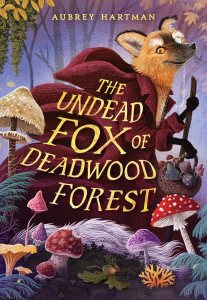
  • Recently my daughter recommended a middle grade novel she’d read to my nine-year-old granddaughter: The Undead Fox of Deadwood Forest, by Aubrey Hartman. This is the tale of a fox named Clare who, after being hit by a car and left to die, is given the choice of becoming “undead,” which means he could be an usher of souls to the afterlife, or he could just enter the afterlife. The afterlife has four realms: Progress, Pleasure, Peace and Pain. Each realm has a welcoming color all its own: progress is green, pleasure, gold, peace, a watery blue and pain, red.
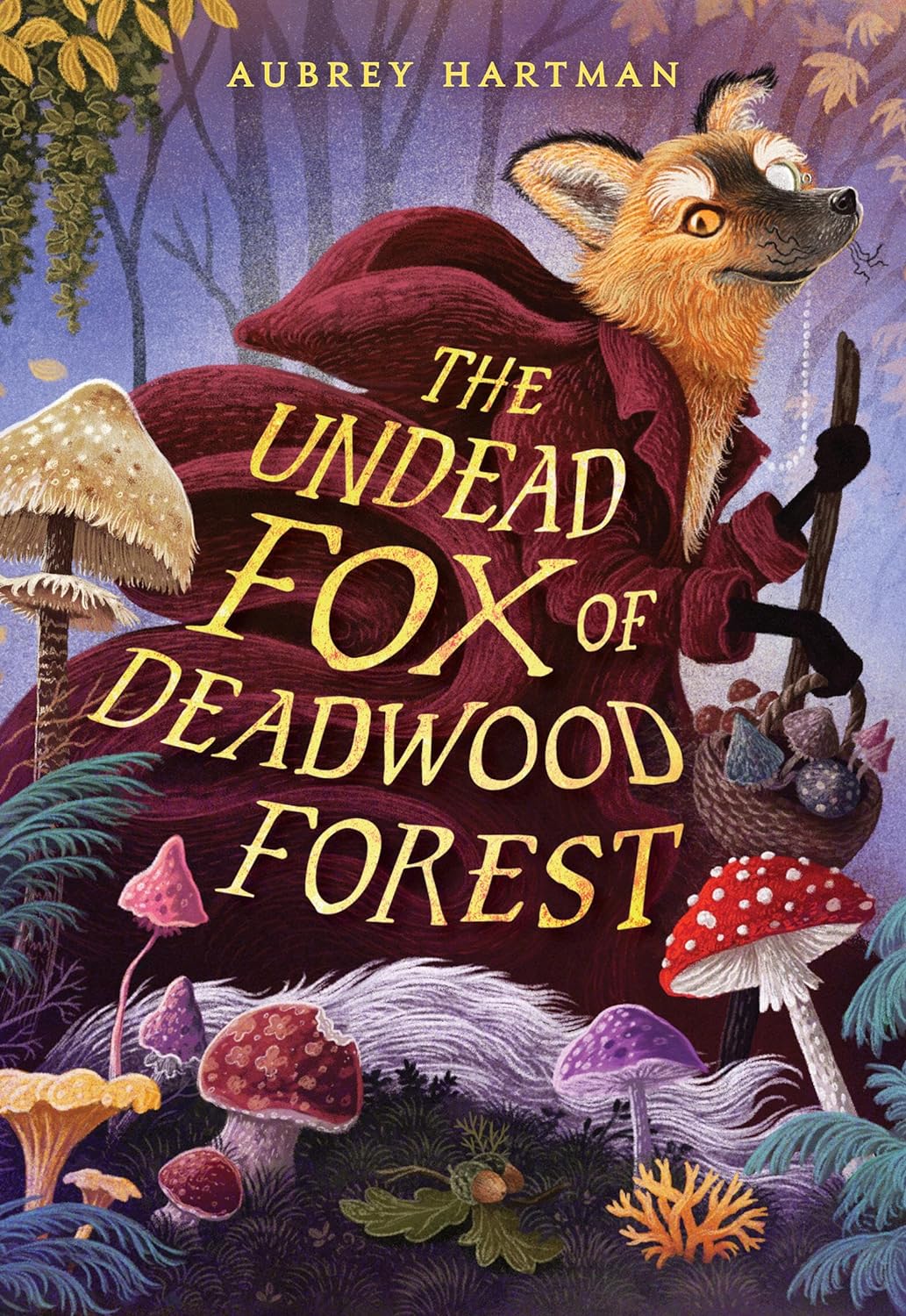
The first encounter in the story is with a particularly nasty bear who wants to choose for himself when Clare determines the bear should be admitted to the realm of pain. Clare tells him, “’But if you try to enter a world where you don’t belong, you’ll wander for a long time. And eventually, finding nothing but the endless stretch of Deadwood Forest, you’ll end up back here, where we will have to repeat the process.’” Clare finally convinces the bear to go to Pain because, “’Just think, then, of all the suffering you could inflict on others…’” “This argument was always convincing to any animal who truly belonged to Pain.”

After the bear enters the realm of pain, Clare prepares to rest as ushers are given three days rest before the Afterlife sends them another soul. But it’s not to be. A badger, named Gingersnipes, turns up at his door that same night.  Clare hates badgers. It was a badger, after all, that left Clare to die in the road after he’d been hit by a car. After trying to send Gingersnipes to Pain she quickly returns. Despite his best efforts, she keeps getting sent back from realm after realm. The reason for this mystery only becomes clear much later in the story.

There are many twists and turns to the plot including a prophecy that says, “On All Hallows’ Eve, Deadwood will bring mayhem to Fernlight. And as the moon sets, the one in Deadwood will vanish forever.” Clare assumes this means he will vanish forever as there are no other animals in Deadwood, except for two mice who live in the garbage dump, hence the name Deadwood. Fernlight is the lush adjacent forest that has many animals and plants. But Clare doesn’t understand how Deadwood could possibly bring mayhem to Fernlight.

This book has so many charming details from the mushroom Clare nurtures and names Captain; the two mice who live in the Deadwood Dump and occasionally give him much needed information; to the monocle and cloak Clare wears to hide his injuries from when he was hit by the car.

This is a kid’s book that deals with heavy issues such as death, grief and loss. Not surprisingly, Hartman wrote it during the pandemic. But it is not a dreary story at all. Full of humor and even joy kids may understand it on a different level than the adult reading it. But perhaps I’m mistaken. Madeleine L’Engle, when accused of writing children’s books that were too complex for kids to understand, she replied, to paraphrase her–children understand. My books may be too complex for adults.




Posted in Uncategorized | Leave a comment

Lazy Summer Reading


I haven’t written anything in this space for a year, and I apologize. My mother used to say, “Life is too short to…” any number of things. I used to think that was a weird thing to say. I’m in my 70s now, however, and I realize how true it is.  This past year has just flown by.

I have been reading more books than ever. I just haven’t taken the time to actually write a review of all the great books I’ve read.  I have also been busy writing-that is my main focus, right?  And submitting. Ugh. That trilogy? I still haven’t found an editor or agent to bite on the first book. Friendly feedback letters, go something like this, “I found the premise interesting but it’s not right for our line right now. Just because it wasn’t right for me doesn’t mean it won’t be exactly right for someone else. Good luck on your publishing journey.” Double ugh.

On a lighter note, on the advice of my granddaughters, I’ve been reading fun middle grade and young adult novels. The soon to be thirteen-year-old granddaughter is into YA.  The younger one is into chapter books and soon to be middle grades. To All the Boys I’ve Loved Before and The Summer I Turned Pretty, both by Jenny Han, are the first books in two separate trilogies. Perfect beach reads. No worries though, I plan to get into heavier topics this school year and even review the occasional book a grown up might like.

In the meantime, I recently read an article in Publishers Weekly that is really disturbing. Google has launched a personalized Storybook app called Gemini. It offers “personalized stories with read-aloud narration as an option.” This chatbot is spitting out picture books of dubious quality. Among the typical AI problems are characters with extra limbs and mostly defaulting to white characters. But, as Sarah baker, executive of the Society of Children’s Book Writers and Illustrators points out the app “gives neither credit nor compensation to the humans who made the work it trained on, which was essentially stolen.” A link to this article follows.

https://www.publishersweekly.com/pw/by-topic/childrens/childrens-industry-news/article/98452-google-launches-personalized-gemini-storybook-app-to-industry-concern.html


See you soon!

Posted in Uncategorized | Leave a comment

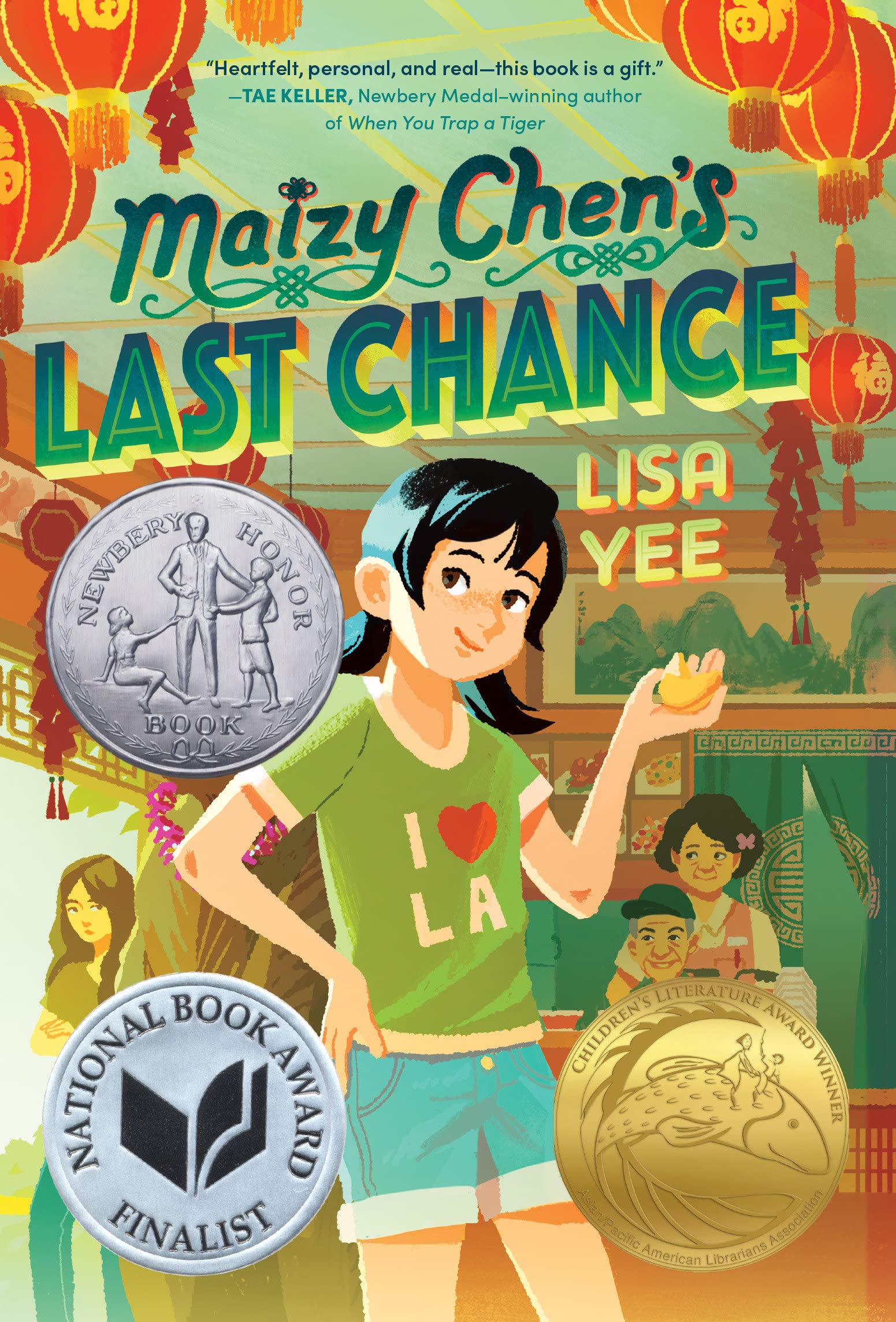
Maizy Chen’s Last Chance is More than a Fun Read

Maizy Chen’s Last Chance by Lisa Yee. Random House Children’s Books, New York, NY, 2022. Middle Grade.

Maizy is spending the summer in Last Chance, Minnesota, because her grandpa is ill. She and her mom live in Los Angeles, and Maizy had other plans. Last Chance is a major culture shock. To make things worse, she accidentally dropped her cell phone down a well her first day there.

Maizy’s grandparents own the Golden Dragon, a Chinese restaurant in town. Her Grandpa and Grandma work there 24/7. When Maizy’s mom takes Grandpa to the doctor, she comes home and tells Maizy he is sicker than she thought. From now on, he is not to work at the restaurant, so Maizy and her mom are going to help out for the summer. When Maizy is asked to keep Grandpa company at home, she discovers that spending time with him and hearing his stories about the Chinese “paper boys” is the best part of her day. His stories keep her on the edge of her seat.

 Maizy’s father is not in the picture, but will an interesting man, the local high school principal, catch mom’s eye? When she finds her mom’s yearbook in the local library, she discovers that they were once a couple. She also sees her mom’s quote from senior year: “Goodbye, Last Chance, Hello, World.” Is it because Mom left Lance Chance right after high school that she and Grandma don’t get along?

This novel has a lot in common with Hour of the Bees, by Lindsay Eager. Like Carol in Bees, Maizy has a grandpa who tells important stories, and, like Carol’s dad and grandpa, Maizy’s mom and grandma do not get along.

There are so many mysteries to solve: Why is Grandma so mad at Mom? Is Grandpa going to die? Why is he fighting with his best friend? Meanwhile, someone has stolen Bud the Bear, a statue that has stood outside the Golden Dragon for decades. Shortly after it is returned, racist graffiti is sprayed all over it. Who are the vandals? Will Mom marry the principal?

When she’s not trying to figure out the answers to all her questions, Maizy waits anxiously for Grandpa’s next installment about the first Chinese immigrants who came to Last Chance.

My 11-year-old granddaughter wouldn’t leave me alone until I read this novel. She loved it that much. Maizy Chen’s Last Chance is a novel that I probably read too fast and will have to re-read, because I couldn’t put it down and had to know what was going to happen next. It’s a fun read, but so much more than that. Its discussion of racism, both past, through Grandpa’s stories, and the present time is particularly timely. 

Maizy Chen’s Last Chance is a Newbery Honor book, a finalist for the National Book Award and the 2022-2023 Asian Pacific Librarians Association Award winner for a Children’s middle grade novel.

Posted in Uncategorized | Leave a comment

The Patron Thief of Bread a Delicious Middle Grade Novel

The Patron Thief of Bread by Lindsay Eager. Candlewick Press, MA, 2022.

At eight years of age, “Duck” is the youngest of the Crowns, a gang of dirty, thieving orphans. “Gnat” is the leader of the group and on this day, he chooses “Duck” to steal bread from Master Griselde’s bakery. The Crowns have just moved to Odierne, a town new to them. Once they have “used up a town” and find themselves pickpocketing the same people over and over, they move on.

Gnat hands Duck a “coin” to take to the bakery. But this is not real money. It is money they have fashioned out of an old wagon wheel to look exactly like real money. Only on Saturdays does the baker have fresh bread, hot out of the ovens. To this group of children, it is the best food they have all week, as they are usually reduced to eating “rotten onions, unripe berries and the occasional squirrel.”

This is the first time Gnat has entrusted Duck with this responsibility. She is the quietest  of the gang. In fact, Ash, another member, has always spoken for her. He had fished her out of the river when she was a newborn, fed her goats milk and has always looked out for her.

Duck is terrified of this new task Gnat has given her, but she must do it. No one turns down Gnat. When she realizes the baker is mostly blind, Duck has no problem fooling the woman with the fake coin. As she walks home with seven loaves, “Their scent was so intoxicating, their crusts a hard warm comfort against her body as she walked out of daylight and into the chilly morning shade created by the towering cathedral. She inhaled, and a note of something unexpected hit her nose. Rosemary. That was the herb that always found her. Rosemary.”

When the baker eventually hires Duck, she is expected to steal from the woman for the Crowns and Duck does so, but there comes a point when she must decide who to be loyal to and whom to betray. Meanwhile, an almost human gargoyle, who acts as narrator, watches over the town and the people in it from atop a never finished cathedral.  

The Patron Thief of Bread is a wonder of a middle grade novel. The world building is so real the reader believes there really are gargoyles who argue among themselves. The cathedral, in which the Crowns have made their home, is a character in itself. Run down, full of crumbling bricks and rats that scurry about, it is always there, in the background with the gargoyles looking down.

There is a lot more that could be said about this novel, but then I’d be giving too much away.

This is a tale of loyalty and betrayal but ultimately empathy. The description of the bakery is in such vivid detail the reader can almost smell the baking bread.

Posted in Uncategorized | 1 Comment

Trust and Betrayal are Themes in The Last Mapmaker

The Last MapmakerThe Last Mapmaker by Christina Soontornvat. Candlewick Press, MA, 2022.
Middle Grade

Sai is the assistant to the most respected mapmaker in Mangkon: Paiyoon Wongyai. She is lucky to have this job, as she cleverly lied her way into it. She pretends she is just like all the other assistants in Mangkon: someone of respected lineage, soon to turn thirteen and get her first lineal, a small golden gem that represents her proud ancestral line. But she’s a fraud. She has no proud lineage. Her father is a con man and any money she earns goes back to him. What he doesn’t know is that she has been keeping half of it for herself and it is buried where no one will ever find it. Someday, she plans to take that money and go far away from her father and his schemes.

When an amazing opportunity presents itself, Sai thinks this is her chance to finally leave Mangkon. Master Paiyoon has asked her to accompany him on a voyage to map the southern seas. She jumps at the chance. Paiyoon recognizes her skill at mapmaking, but what he doesn’t realize is that she is also an excellent forger—a trait her father took advantage of.

Sai plans to leave Mangkon, but she doesn’t tell Paiyoon that she is planning to take her saved up money along and when they get to a respectable port, she will not return to the ship, but instead, create a new life for herself in a new place. When circumstances interrupt her plans, she must make a decision about who to trust—and who to betray.

This story has much the same themes as Lindsay Eager’s The Patron Thief of Bread. (Watch for a review of that coming up.) A young girl, dependent on unsavory people for her very livelihood, finds herself planning to betray the one person she trusts—and who trusts her.

The Last Mapmaker is a well-crafted novel, with many twists and turns and a sub plot that ties them all together. Such excellent writing, I couldn’t put the book down.

Posted in Uncategorized | Leave a comment

Generations Find Common Ground in “Grandma’s Window”

Grandma’s Window by Janet Halfmann, illustrated by Christy Tortland. Brandylane Publishers, Inc. Richmond, VA. 2023

“Mateo sat alone on the way to his new school. Everyone on Bus 22 seemed to have a friend and he felt left out.”

Grandma’s Window depicts what it feels like to be all alone at a new school. Especially when riding the bus without a friend to sit with, this feeling can be overwhelming. But one day, what if you saw something unusual out your window? A hand, maybe, waving?

This is the premise of Grandma’s Window. One day, as the bus goes by a purple building, Mateo spots a woman, a “grandma,” waving from a window.  He shouts to the kids on the bus to wave back and they do. Ultimately, because of this, Mateo makes a friend who sits with him on the bus and at lunch. Every day, going to and from school, the kids wave to the “grandma” in the window. Then, one day, she’s not there. And the next, and the next. The kids worry, and the bus driver finds out the woman is now living in a nursing home. When they visit and find out Grandma is having trouble making friends, Mateo comes up with an idea to help her.

Based on a true story of kids and their special “waving grandma” who waved to them for five years, the story ends happily with the kids finding a new way to not only visit Grandma but help her make friends too.

The illustrations by Christy Tortland of a diverse group of children have muted, natural colors with many different skin tones. This is a sweet story of a child who “pays forward” a kindness shown to him.


Posted in Uncategorized | 1 Comment

Summer Reading

I’ve been reading a lot this summer. Stay tuned for more reviews.

Rust in the Root by Justina Ireland. Balzer + Bray an imprint of HarperCollins Publishers, 2022 New York, NY.

YA

It’s 1937. FDR is President. There is a blight across the land. But wait—the Depression is somewhat different in this universe.

“At the Urging of President Franklin Delano Roosevelt and with the approval of Congress, the Department of the Interior’s Mechomancy Division and the Bureau of the Arcane today announced a collaboration to remediate the scourge of environmental blights throughout the United States.”

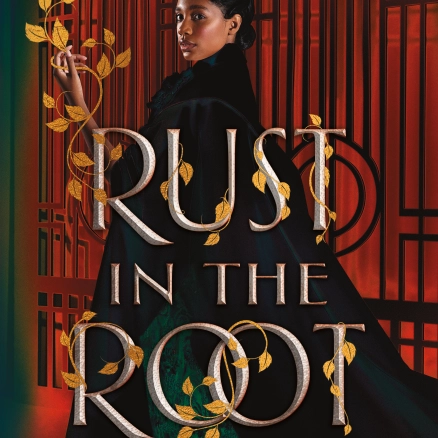
In this alternate universe, the Depression is the “Great Rust” and the world is ruled by magic. Peregrine, a new apprentice in the Arcane’s Conservation Core, Colored Auxiliary, discovers her full potential as a mage. The Colored Auxiliary is blamed for the “Great Rust” and so they are sent to remedy it: a dangerous undertaking. This is the JimCrow era and the Auxiliary is considered expendable.

The plot of Rust is fascinating, as Ireland creates a clever story that parallels the Great Depression and racism while weaving magic throughout.

I assume this is Young Adult mainly because the complicated plot involves so much U.S. history that most Middle Grade kids wouldn’t have yet learned, but it’s a great read for any age.

Hour of the Bees, by Lindsay Eagar. Candlewick Press, Somerville, MA, 2016

MG

Family secrets abound in this middle-grade fantasy that deals sensitively with dementia. The main rule, which Carol’s father has stressed over and over again, is to not upset Grandpa, and this means never mentioning Rosa, Carol’s Grandma, and Grandpa’s long-deceased wife. Carol is dreading the summer at his ranch in the most desolate, drought parched, area of New Mexico. She’s never met Grandpa Serge, because of some falling out her dad had with him. When she finally meets him, he calls her Rosa. Often throughout the story he gets her confused with his dead wife, but when he’s more lucid, he calls her Carolina, pronounced Caroleena and urges her to be proud of her heritage.

Bees are a significant character in the story as Grandpa keeps saying when the bees return the lake will return. Everyone thinks this is foolish because logically, it’s just the opposite: the bees may come back if it ever rains again.

But Grandpa’s faith in the bees is unshakable and when Carol is the only family member that is being followed around by bees, she begins to wonder if Grandpa’s stories about a lake, a magical tree and people who lived forever might be true.

Hour of Bees is a sensitive portrayal of dementia and how story-telling can open doors to a profound communication that can certainly feel magical.


Posted in Uncategorized | Leave a comment

If you follow the Goodreads review site, you will see that they have a new list out as of March: 100 books banned by school districts in Florida. These books were initially pulled “for review” in Duvall County, a county that has 40% disadvantaged and 70% minority students.  I decided to check out three of these books: Dim Sum for Everyone; Before she was Harriet and Henry Aaron’s Dream.

Dim Sum For Everyone, written and illustrated by Grace Lin (Dragonfly Books, Random House Inc,  New York, 2001). This delightful story begins: “Dim Sum has many little dishes.” Pictured is a family sitting at a table in a restaurant in China Town. Their plates are empty and the youngest looks anxiously at a nearby cart filled with little dishes. The next picture shows waitstaff pushing carts of delectable treats among a diverse group of customers seated at tables, happily eating. Finally, the storyteller’s table gets to choose their food. They all pick something different and then “Everyone eats a little bit of everything.” The final two pages explain how the tradition of eating small dishes came to be. What’s not to love about this book? I can’t explain it. This book was one of 176 that were pulled for review in Duvall County, Florida. As of this writing it is unclear if it is back on the shelf.  If you don’t want to read about another culture’s food then don’t, but others may want to so – how about you LEAVE IT ON THE SHELF!

Before She Was Harriet by Lesa Cline-Ransome, illustrated by James E. Ransome. Holiday House, New York, 2017. “Here she sits an old woman tired and worn her legs stiff her back achy…”  Thus begins the story of Harriet Tubman. Written in blank verse, the story takes the reader back in time and describes a life dedicated to others. This is a beautifully illustrated book that tracks Harriet Tubman’s life from the time she was a young girl named Araminta to her travels and well-known work on the Underground Railroad. Less well-known is that she was a Union spy, a suffragist, and a nurse. Again, what is the thinking behind possibly banning this book? Perhaps school district administrators simply don’t want kids to read about slavery. You think? As of this writing, it is unclear if it is back on the shelf.

Henry Aaron’s Dream by Matt Tavares. Candlewick Press, Massachusetts, 2010. Another beautifully illustrated book. “Henry Aaron had a dream. He wanted to be a big-league baseball player. He didn’t have a bat so he’d swing a broom handle or a stick or whatever he could find.” In 1940s Mobile Alabama it was against the law for Black and White kids to play together. Baseball diamonds had signs up: Whites Only. But when Henry was twelve, a baseball diamond opened with a sign that said: Colored Only. Henry had an odd way of holding the bat: he batted right- handed with his left hand on top. Still, he hit the ball harder than any other kid. In 1947, when Jackie Robinson joined the Brooklyn Dodgers, Henry listened to every Dodger game on the radio. Full disclosure, while describing the racism and abuse Jackie endured Tavares does use the “n” word. In 1952, Henry started playing for the Indianapolis Clowns in the Negro Leagues. The players slept on buses and didn’t stop at restaurants because they were not welcome in hotels or eating establishments. One day, a scout for the Braves saw Henry and asked him if he would try batting with his right hand on top. The Braves quickly signed him up for a minor league team. But Henry soon experienced the same racism Jackie Robinson did. “Henry focused on the ball and tried to ignore everything else.” During an exhibition game the Braves played the Dodgers and “Henry smacked a line drive into left field and slid into second, just beating the throw from the left fielder, his hero, Jackie Robinson.” Henry had made it to the big leagues. I’ll admit the use of the “n” word could be problematic as a trigger, however, banning the book is not the only solution. After initially pulling the book in Duvall County, as of February 13 it is being allowed to be used for third grade and up.


Posted in Uncategorized | Leave a comment

Zee Grows a Tree is a Wonderful fiction/non-fiction Choice for the Classroom and Home

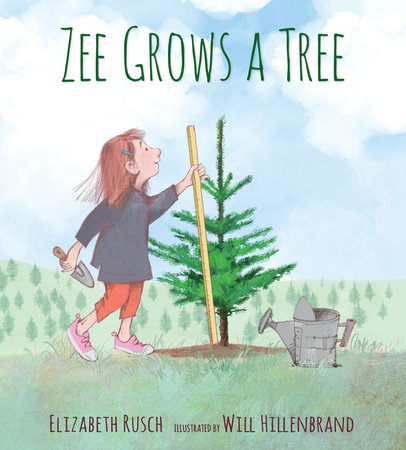
  • Zee Grows a Tree by Elizabeth Rusch, illustrated by Will Hillenbrand.  Candlewick Press, Somerville, Massachusetts, 2021.

“One morning, little Zee Cooper arrived in the world. The very same day, a Douglas-fir seedling emerged from the soil at Cooper’s Christmas Tree Farm.” Zee Grows a Tree, much like Butterflies Belong Here,  is a fictional story packed with facts about evergreen trees. The facts are in smaller print than the storytelling on each page. Back matter has an index that challenges the reader to look up the pages, for example about seeds, branches, buds, etc.… It instructs the reader to remember to look up both kinds of words—both big and small.

As little Zee grows, her tree grows also. At first, while she is a baby, the fir tree spends its life in a nursery, where it is protected from insects, animals, and diseases. On this page Mom and baby are in a greenhouse. Mom is leaning over the seedlings with little Zee in a sling across Mom’s chest.

“After just a few years, Zee was ready to start preschool—and her tree was ready to start life outside the nursery.”   While Zee is learning new things and making new friends at school, her little tree is meeting animals and experiencing changes in the weather for the first time.

On Zee’s fourth birthday her father measures her. She is smaller than the other children in her class. Her tree is small too, but she reassures it, like her father reassured her, “Don’t worry…everyone grows at different rates.”

The rest of the story marks time as Zee goes to kindergarten, first and second grade.  A very hot summer with little rain causes her tree’s needles to turn brown. Some of them fall off. The author points out that on a tree farm, most farmers don’t water their trees and any damage from drought usually disappears once it starts raining again. But Zee waters her tree, even sharing her freezer pops with it.

When she turns eight, her tree is finally large enough to become a holiday tree. But the family leaves the tree in the ground and decorates it outdoors. Zee is now tall enough to reach the top.

This is a lovely book about a little girl and her special tree. The mixed media illustrations depict a family working together to nurture a very special little tree. The youngest child will delight in the story, and older readers can use the information for research.

The back  matter discusses how to care for a living tree and lists other resources for further study. I would shelve this with Butterflies Belong Here in the non-fiction section of my classroom library.

Posted in Uncategorized | Leave a comment

Threats to the Rain Forest the Subject of Charming Picture Book

Zonia’s Rain Forest by Juana Martinez-Neal. Candlewick Press, Somerville, Massachusetts, 2021

“Zonia lives with those she loves in the rain forest, where it is always green and full of life.” So begins the story of a small girl whose family lives in harmony with the natural world. The first illustration is of Zonia looking on, while her mother nurses her baby brother.

The next pages show Zonia greeting the various creatures of the rain forest. She first encounters the Blue Morpho Butterfly, which follows her throughout the story. All of the creatures she meets are identified in the back matter. The illustrations reflect the subtle hues of nature, but with the occasional vibrant coloring such as the butterfly, the Andean Cock-of-the-rock, and the giant Amazon Lily.

After greeting all her animal and plant friends, Zonia heads home to see her mother and baby brother.

“On her way home, Zonia comes across something she has not seen before.” A large piece of the forest is gone. Zonia is pictured standing among the only greenery left as she gazes at the wreckage. The blue butterfly perches on top of one of the tree stumps left behind by loggers. She rushes home to tell her mother that the forest needs help.

“’It is speaking to you,’ says Zonia’s mama.”
“’Then I will answer,’ says Zonia, ‘as I always do. We all must answer.'”

The final page shows a small, determined girl intent on saving her friends of the rain forest.

The back matter explains that Zonia is Ashaninka, the largest Indigenous group living in the Peruvian Amazon. Today, they are fighting to protect their land from development. “At times, the Ashaninka use plant-based paint on their faces or bodies to complement their actions or abilities.” On the final page of the story, Zonia is shown with this red type of face paint which signals strength and determination.

There is information about the importance of saving the Amazon and the many threats to its existence on the final pages. In the acknowledgments, the author/illustrator thanks “…the women paper artisans of Chazuta who hand-made the paper used to paint the illustrations in this book.” The use of mixed media, including linocuts and woodcuts, on banana bark paper invokes a feeling of being in the forest with Zonia. The simple text, along with the engaging illustrations, will engage even the youngest child.

A perfectly stunning book.


Posted in Uncategorized | Leave a comment