OdinsPromiseI recently interviewed Sandy Brehl, the author of Odin’s Promise, A Novel of Norway. (Published by Crispin Books, an imprint of Crickhollow Books, Milwaukee WI 2014) We spoke via Skype.

SGL: You say that Odin’s Promise started as a picture book, morphed into an adult story and finally ended up a middle grade historical. Tell me a little about that Journey.

SB: I tell people my book took 35 years and one year to get published. The inspiration for what I thought would be a picture book came when I first visited Norway 35 years ago. I went with a friend who had many relatives there. They told us stories about what it was like during the German occupation. All evidence of old Norway were removed and replaced with a ‘New Norway’ flag representing a partnership with the Nazis. I saw these stories as richly illustrating a picture book. I knew enough about picture books, but didn’t know that I really needed to have little kids in it!

SGL: When did you realize it wasn’t a picture book?

SB: I sent it to a book doctor who told me it wasn’t a picture book, but if re-worked, it could work as a book sold in museum gift shops.

(Sandy explains here that she worked as a teacher in classes for regular grades and special needs students for 40 years. After retirement she had more time to write.)

SB: I re-worked the picture book as an adult book. I had it vetted on cultural authenticity and had good feedback. I was in a critique group that was working on adult writing and they loved it.

(Around this time Sandy became a member of the Society for Children’s Book Writers and Illustrators – SCBWI. She joined a critique group that was working on picture books. Eventually she was advised to make the story middle grade.)

SGL: During revisions, you said you read a dissertation that opened your eyes to the resistance in Norway.

SB: The dissertation, by Kathleen Stokker, PhD, was “How Folklore Fought the Nazis.” Young people in Norway were finding ways to resist the Nazis by using their humor and culture. For example, celebrating the festival of Syttende Mai was forbidden. One of the stories I heard while in Norway was that one couple purposely planned their wedding for that day, like the couple in the book. Another way they resisted was by hiding radios to listen to the BBC to find out progress of the allied forces or the fate of exiled King Haakon VII. Radios were forbidden by the occupying army.

SGL: Mari, your main character, finds her voice and helps the underground in her own way. Were you shy as a child? Is Mari based on you?

SB: She wasn’t based on me in any way while I was writing. She struggles to find a sense of power or control her world. I, growing up, thought I could control the world. If I have a role, I run with it and do it confidently, like being a teacher. But if I don’t have a designated role, I just as soon not be there. I’m really uncomfortable in strictly social settings. Something I discovered after I wrote Odin’s Promise is that Mari is very much like stories my mother told me about herself. She grew up in a very rural area of Kentucky. She was great in school. Her siblings were all much older than she, so she grew up shy and with a dog as her best friend.

SGL: How long have you been writing? Did you dream of being a writer when you were a child?

SB: No. In general, I did well in school. I thrived—it was a role I could take on to define myself. I always wrote competently. Writing assignments were functional, not really creative. My mother was always a writer. She had things published and kept multiple journals. I did not keep a journal. I didn’t consider writing a viable career. When I hear kids say they love to write I tell them not to give up on writing as a career.

SGL: You mentioned in a blog post that there are a handful of characters from books you read when you were young that stayed with you. Can you name a couple and why they had an impact on you?

SB: At an early age I read a book called Dibs in Search of Self. It was written for adults and it was about a child who is seeing a therapist. When the child hears the words “rain forest,” he pictures the roots of a forest raining down and destroying everything, a very terrifying image. Another book that impressed me was Clay Fingers, a book about a therapist who used clay in therapy. Both of these books convinced me that I wanted to work with kids who needed extra support.

SGL: Is Odin’s Promise your first attempt at publishing? Have you had many rejections?

(Sandy laughs) SB: I wrote a Christmas story as a result of a fender bender. I didn’t have a lot of money to pay to have my car fixed up so I thought maybe I can write a Christmas story and get paid for it. It was already October. I was thinking it could be published in time for Christmas! That was rejected but I ended up giving it as a gift that year because I had no money for gifts. After that I began reading Children’s Writer and Illustrators Markets and other resources. I have file drawers full of rejection letters. I used those with kids all the time. I used them in my classroom when I was teaching to show them what editors said about my writing. When teaching kids writing, looking at early drafts is important.

SGL: What’s next for you? What are you working on now?

SB: I have a lot of Norway research far beyond the first year of occupation, so I am considering a sequel. It was not my original intent, but readers have expressed interest. I have two picture book manuscripts that I am sending out, two more that I’m re-working with my critique group, and many others in various states of development. I’m also working on a graphic style book and a middle-grade contemporary with a male character.

SGL: Do you have any appearances coming up?

SB: Marketing this release is my current project. The schedule of events is just now starting to fill in and I welcome inquiries about appearances. A study guide was piloted before the book released, which is now offered on my website. I’ll meet with a middle grade ‘lunch bunch’ at New Berlin Public Library in August, speak to a Rotary Club in July, have a signing at Whitnall School District on September 13 from 2:00-3:00. In March 2015, the Wisconsin Norwegian Elkhound group will host a national gathering in Wisconsin. They are giving signed copies of my book as prizes to winners, and I’ll have a presentation and signing session there. My website is being revised this summer and a full calendar will be posted there. The contact tab can be used now to inquire about visits and signings.

Sandy finished our interview by joking: “If I can get one book published every 35 years I’ll shoot for a career!”

After reading Odin’s Promise I’m convinced she won’t have to wait that long. Her readers will be anxious for more.

Sandy can be reached here   Check her out on Twitter at: @SandyBrehl and @PBWorkshop She is also on Facebook.

See her publisher for other great kid’s books: www.crickhollowbooks.com

Posted on by stephanielowden | 1 Comment

stranger next door smallToday I am featuring an interview with Goldie Alexander, an Australian writer.

What is the name of your character? Is he/she fictional or a historic person?

My main character is Ruth. She is fictional.

When and where is the story set?

This young adult story is  set in Melbourne Australia in 1954, during the Cold War. It’s both a spy story and a romance.

What should we know about her?

In 1954, Melbourne is still reeling from WWII, the Cold War sees suspicions running high and the threat of communism and spies are imagined in every shadow.  Jewish schoolgirl, Ruth, is trying to navigate her own path, despite her strict upbringing and the past that haunts her family. A path that she wishes could include her first love, Patrick, but the rich, Catholic boy is strictly off-limits. 

What is the main conflict? What messes up his/her life?

Not being given the freedom to pursue her own romance. 

What is the personal goal of the character? She wants her family to be safe, but she also wants Patrick, a Catholic, and therefore strictly forbidden. She also wants to study medicine but her mother thinks this is pursuing too high an ambition.

Is there a working title for this novel, and can we read more about it? The established title of this Young Adult novel is “THAT STRANGER NEXT DOOR”. The publisher is www.clandestinepress.com.au

Here is a little more about it:

“When a mysterious woman moves in next door in the dead of night, Ruth becomes convinced that she is none other than Eva or Evdokia Petrov, a Soviet spy and wife of famous Russian defector, Vladimir Petrov. Could the woman who Ruth starts an unlikely friendship with really be the most sought after woman in Australia? Will Ruth’s own clandestine meetings be discovered? How does the Petrov Affair, as it became known, impact the life of one ordinary girl and her family?”

When can we expect the book to be published?

This novel is to be launched at the beginning of June at a Writer’s Festival in Melbourne Australia.

Here’s how to contact Goldie and a list of her publications:

GOLDIE ALEXANDER

www.goldiealexander.com

www.goldiealexander.com/blog 

Out Now::

Neptunia ( middle school fantasy) http://www.fivesenseseducation.com.au

Penelope’s Romance: (adult fiction) http://www.boroughspublishing group.com

Coming Soon:

That Stranger next Door:(Historical Fiction): Clandestine Press

Cybertrix 2043 (middle school science fiction) http://www.fivesenseseducation.com.au

In Hades(YA verse novel) Celapene Press

Posted on by stephanielowden | Leave a comment

JingoCoverI am participating in the latest “Blog Hop” but with a change. I will be posting the interviews of the two writers I tagged on my own blog. Their links follow this interview.

Elizabeth Caulfield Felt tagged me in her most recent post. She is the author of the adult historical “Syncopation” and the children’s mystery, “The Stolen Golden Violin.” Visit her blog at elizabethcaulfieldfelt.wordpress.com

The following questions pertain to my historical fiction novel Jingo Fever.

What is the name of your character? Is he/she fictional or a historic person?

My main character is Adelle. She is fictional.

When and where is the story set?

The story is set in Ashland Wisconsin in 1918 during World War I.

What should we know about her?

Adelle, a city girl, feels trapped in Northern Wisconsin for the summer. She and her mother have come here to help care for her uncle who is recovering from influenza.  Adelle wants to go home to her friends in Milwaukee. But her most important wish is to hear from her brother who is fighting for the Allies over in France. The family has not heard from him in a long time and Adelle imagines the worst happening to him.

What is the main conflict? What messes up his/her life?
The thing that messes up her life is being stuck up north for the summer and being bullied by local boys because she is German-American. People of German descent were under suspicion and her family suffers because of the jingoistic atmosphere during the war.

What is the personal goal of the character?
She wants to go home, but most of all she wants her brother to be safe, something she has no control over.

Is there a working title for this novel, and can we read more about it?
The title of this middle grade historical novel is Jingo Fever. You can read more about this novel and my other middle grade, Time of the Eagle, on my website: www.stephanielowden.com

When can we expect the book to be published?
Jingo Fever came out in 2011 from Crickhollow Books.

Now it is my turn to tag some author friends. I am going to be posting their interviews soon.

Goldie Alexander at:  http://www.goldiealexander.com  Author of Neptunia ( middle school fantasy) www.fivesenseseducation.com.au  That Stranger next Door:(Historical Fiction): Clandestine Press     In Hades(YA verse novel) Celapene Press 

Patricia Curtis Pfitsch at: www.patriciacurtispfitsch.wordpress.com Riding the Flume (middle grade historical mystery). 

Posted on by stephanielowden | Leave a comment

“Smasher” Will Delight Techie Fans of Sci-Fi.

18371575[1]Smasher by Scott Bly. Blue Sky Press, an imprint of Scholastic Inc., New York, 2014. Ages 8-14; grades 5-8.

“Day after day Grandfather barked at Charles, snapping instructions. …‘You must prepare! Remember the prophecy: A time will come when the Hum will no longer serve us—no one will feel it, or even believe in it….Study boy! You’re the new generation. Study to keep it alive.’”

Twelve-year-old Charles chafes under his grandfather’s rules. He doesn’t want to study. In fact, he’s planning on running away. But when he is visited by robotic, time traveling, Geneva, a girl from 2042 who insists he travel to the future to save it, he’s not sure he wants to run that far away.

At first glance I wasn’t at all sure I was going to enjoy this book. The first few pages, describing a boy in the 1500’s speaking like a kid in the 2000’s, was off-putting for this historical fiction fan. In the authors note, Bly explains that he wanted the language to be accessible to today’s kids, so he had Charles (who soon goes by Charlie) speak like a contemporary twelve-year-old. It was probably the right decision for his target audience.

Geneva needs Charlie to help save the future because Charlie has a special gift. In Charlie’s time, many people are aware of the “Hum,” a magical power. Only a few people, however, know how to use it. Charlie’s family does. At first Charlie doesn’t trust Geneva, because his grandfather has told him not to trust anyone: he could end up dead because people with such power have been persecuted. But Charlie has another gift that Geneva needs. He is a math genius.

Smasher is a fast moving page turner that even a non-techie like me enjoyed. Just to be clear, there is a lot of math and techie speech in this book that a phobic like me didn’t even try to understand. The action, though, and the premise, hooked me. Two kids with special gifts out to save the world will pique my interest every time.

It took me awhile to get used to the omniscient voice. Because of that, I felt I didn’t really know Charlie, the main character, until much later in the story. Geneva was a more fully developed character from her first appearance. But those are minor points. This book will be devoured by readers who are into science fiction with a dab of fantasy.

Posted in Uncategorized | Leave a comment

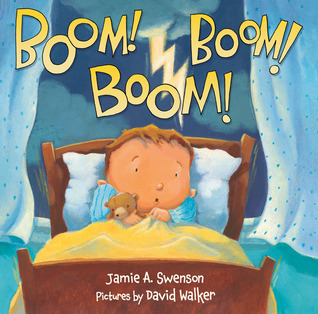
Boom Boom BoomBoom! Boom! Boom! By Jamie A. Swenson, pictures by David Walker. Farrar Straus Giroux, New York, NY, 2013.

When this book came out, I knew I had to have it. No, not for my grandchild, although I’m sure I will read it to her in the future. This one is for me. You see, I really am afraid of storms.  If it even looks like a tornado could form, I’m down in my basement.  The story is told that when I was very young, I was standing next to our barn when lightning struck its lightening rod. All I remember is my mother’s scream. I was completely unharmed, but that clinched it. I do not like storms.

The small boy in Boom! Boom! Boom! settles into bed with his stuffed bear, Fred.  When thunder starts crashing around outside they are joined by the dog.  Pretty soon the cat joins them, then guinea pig, frog, parrot, snake and finally, “Sis jumped in with elbows flying. The bed groaned, and creaked and then stopped trying.” In the end, the small boy figures out a solution to the destruction in his room and finally gets some sleep.

The cadence of the rhyme makes this one of those books that is just as much fun to read for the adult as well as the child. David Walker’s eye-catching illustrations will appeal to the youngest child.  But beware!  They may want to bring all their toys and pets to bed with them.

Posted on by stephanielowden | Leave a comment

Flip, Float, Fly a Perfect Book for Right Now.

Flip, Float, Fly Seeds on the Move by JoAnn Early Macken, illustrated by Pam Paparone. Holiday House, NY, New York, 2008.

EPSON scanner image

Be prepared to appreciate those maple seeds inhabiting your planters and dandelion seeds floating through the air when you read this book.  Like many a gardener I fight with those helicopter-like seeds my maple trees seem intent on planting in my container gardens.  And don’t get me started on dandelions.  But being a sometime kindergarten teacher, I know the allure of dandelions to young children.  They seem to just go together: small children and those yellow flowers that most adults feverishly try to eradicate from their yards. Some teachers forbid the kids from bringing them into the classroom, but I’m just an old softie, I guess.  I just don’t have the will to tell a little girl to throw away the dandelions she so carefully picked for me.  (Instead I quietly throw them away later.)

Flip, Float, Fly Seeds on the Move is a lovely non-fiction picture book from which I learned what those weird looking seed pods are that I see sometimes on walks in my neighborhood. Locust tree pods. I don’t have a locust tree in my yard but I see them everywhere and now I know what they are.  I love the tree’s fern-like leaves that seem to turn silver, quivering in the wind.

Early Macken’s perfect prose tells how seeds get carried away and replanted in new places: by water, wind, and even bats: “A bat finds a feast in a fig tree and wings away with the seeds inside.  The seeds pass through its body unharmed and fall to the ground in its droppings.”  Squirrels hide acorns “…and bury them to eat later. But does it use all the food it collects? No. Lost acorns can grow into strong, shady oak trees.”  My yard has a prolific squirrel population so when I’m digging in the soil I’m forever finding acorns the squirrels have “squirreled” away.

The realistic acrylic paintings by Pam Paparone are a riot of color.  One favorite page of mine depicts a garden with everything from carrots to roses.  A small boy carries a potted hydrangea bigger than he and a small dog waits for a ride in a wagon.  A seed package is tipped over in the corner, flower seeds spilling out.  Several pages have easy to read diagrams of the parts of plants, such as the flower, fruit, leave, pod, etc. set off in a white circle so even the youngest child’s eyes will be drawn to them.

The last three pages have diagrams of the parts of plants with definitions and notes on what conditions seeds must have in order to take root, grow and make more seeds.  This is the perfect book to read to that young gardener in your family who is helping parents or grandparents with planting.

Posted in Uncategorized | Leave a comment

Sophie’s Squash: A second look at a gem of a picture book.

Sophie’s Squash by Pat Zietlow Miller, illustrated by Anne Wilsdorf. Schwartz & Wade. New York, NY, 2013.  Sophie's Squash

Ok. I have to admit I love squash. And I enjoy gardening. But even dyed in the wool vegetable haters will be captivated by Sophie and her squash friend, Bernice. Sophie and her parents go to the farm market one day and pick out a perfect butternut squash. “Her parents planned to serve it for supper, but Sophie had other ideas.” It turns out that the squash was “…just the right size to hold in her arms…bounce on her knee” and “to love.”  So Sophie draws a face on the squash and wraps it in a blanket.  When suppertime comes Sophie tells her mom, “I call her Bernice.” Mom decides on pizza.

This delightful book follows Sophie and Bernice as they go to the library, do somersaults and visit other squash at the farm market.  Every night she gives “…Bernice a bottle, a hug, and a kiss.” Her parents console themselves:  “Well, we did hope she’d love vegetables.”

But the life of a squash is short-lived. Inevitably, they become mushy. The way in which  Zietlow Miller leads Sophie to come to learn about the life cycle of a vegetable is endearing. Wilsdorf’s evocative watercolor and ink illustrations beautifully contribute to the satisfying resolution of Bernice’s life.  Finally, Sophie’s Squash is not just a sweet little story, but an avenue into a conversation about the circle of life itself.

Posted in Uncategorized | Leave a comment

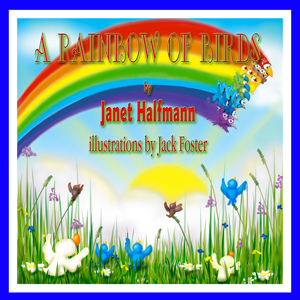
A Rainbow of Birds by Janet Halfmann, illustrations by Jack Foster. Guardian Angel Publishing, Inc., St. Louis, Missouri, 2014. RainbowBirds

The first thing the reader will notice when picking up this book is the vibrant colors of the birds, plants and other creatures portrayed here.  After a rainstorm, Papa bird tells his chicks an imagined folk tale about the origin of the rainbow.  Halfmann cleverly uses the traditional story arc of an origin tale: an older, wise character telling the story to his children or grandchildren.  When the little chicks ask Papa if he was there when the first rainbow formed he says, “No, this happened long before I was born. My father told this story to me, and his grandfather told it to him.”

Long ago, birds were even more active after a rainstorm than they are today. The cardinals were the first birds to fly up after a rainstorm “…forming a band of beautiful bright red.” Robins were next with their orange breasts, joined by yellow warblers, green parrots and blue jays. Indigo buntings and purple martins finished off the rainbow.

This book includes a section titled “Rainbow Facts & Fun” with an explanation of how rainbows are formed and fun projects for kids to try. They can make their own rainbows with a garden hose and watering nozzle, learn to mix primary colors or research other rainbow stories. Many cultures have an origin story explaining this natural phenomenon.

This book will appeal to children of all ages, especially with the experiments in the back of the book. The colors alone will fascinate babies.

The only thing that confused me was Papa Cardinal’s large beak. When I first saw it I thought he was a toucan. But that is a minor point in an otherwise lovely and fun book that will delight readers both old and young.

Posted on by stephanielowden | 1 Comment

Stunning Picture Book Teaches More Than Simple Counting

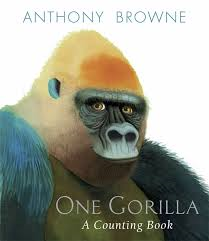
One Gorilla A Counting Book, written and illustrated by Anthony Browne. Candlewick Press, Somerville, MA, 2013.Gorrila

This is the kind of counting book adult readers will never tire of. It’s an art book, a science book and a math book all in one. But it’s even more than that. It’s a book that beautifully  portrays what Pete Seeger referred to as our “rainbow race.”

On the first page we meet a formidable gorilla. Take a good look at his eyes. He’s sizing you up, as if to say, “I recognize you, fellow primate.”

The second page is a blast of orange portraying two orangutans, a mother and baby. The mother looks lovingly at the sweet face of her contented baby. Number three depicts an adult chimpanzee and two chimps. I like to think this adult is a dad. There’s something quite fatherly about the way he’s holding the two “toddlers.”

Every page that increases the number of primates is a riot of color. The mixed media illustrations, portraying our ancestral cousins, jump off the page.

Lest you think the story is over when you get to ten lemurs, turn the page to discover a self-portrait of the author. “All primates. All one family. All my family..” the text reads. Turn one more page and there is our “rainbow race,” a group picture of folks from all over the world. Now look closer. Go back to the previous pages and see if you can match up the human faces with our lesser cousins. This is, quite simply, one of the most intriguing and beautiful counting books I’ve seen.

Posted in Uncategorized | 3 Comments

This Land is Your Land: A review in Honor of Pete Seeger

I am re-posting my review of This Land is Your Land in honor of Pete Seeger’s passing.

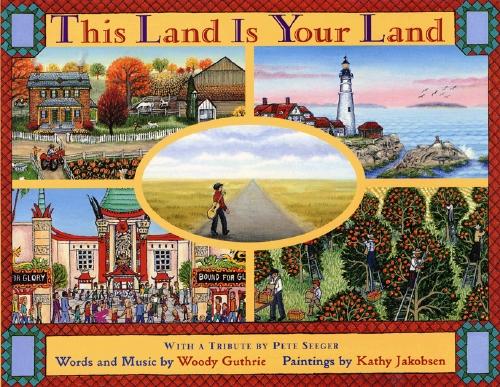
This Land Is Your Land, words and music by Woody Guthrie; Paintings by Kathy Jakobsen, with a tribute by Pete Seeger.  Little Brown and Company, 1998, New York.

This familiar song never “looked” quite so beautiful.  Jakobsen’s paintings successfully depict the beauty of America, while at the same time illustrating the hard times Woody Guthrie sings about.  This edition includes all of Woody’s verses, some of which are conveniently overlooked when school children sing the song.  Those verses, though, are at the heart of what Woody Guthrie stood for.  The first page that illustrates a devastating time in our history is this one: “WThis land is your landhen the sun came shining, and I was strolling, And the wheat fields waving and the dust clouds rolling…”. The painting shows an idyllic farm with blue skies over head.  But look closer: in the distance is the black cloud of dust so familiar to farmers during the “dust bowl”.  Look even closer and the reader sees a farm wife running to her baby—who just moments ago was playing happily on a blanket outside—to get her indoors.  Father and son rush to the horses to get them in the barn and other family members point to the sky. A lot of history is told in that one double spread painting.

Another verse that is often skipped in elementary school, for obvious reasons, is this one: “As I went walking, I saw a sign there, And on the sign it said, ‘No trespassing.’ But on the other side it didn’t say nothing; That side was made for you and me.”

Woody goes on to describe the relief line of hungry people so common during the depression and asks: “Is this land made for you and me?”

As Woody goes walking that “…that freedom highway” another double page painting, shows a community center offering services such as day care, life skills classes and drug rehab.

The pages on which the familiar chorus is sung has intricate, detailed pictures children will love to pore over. The first chorus is accompanied by a full page painting of San Francisco Bay. The facing page—New York City with twin towers intact.

Another nice touch is the addition of tiny little squares, almost like post-it notes, that decorate the corners of many pages.  On these little notes are quotes from Woody, some playful like this one: “Left wing, chicken wing, it’s all the same to me.”  Others chronicle the dust bowl: “You could see the dust storm coming/ The cloud looked death–like black/ And through our mighty nation/ it left a dreadful track.”

Another double spread shows all the singers that have sung Woody’s songs over time. Pete Seeger pops up as well as Ledbelly, Joan Baez and many others.

This book is like a history book. Not the history of wars and battles, but the history of the people of this country: people struggling against nature, hunger and social systems deaf to their needs.  But it is also a celebration of the vast beauty of this nation with its redwoods and wheat fields, mountains and ocean shores.

Well, I could go on and on.  Just buy this one.  Do it.  Give it as a gift to yourself or a friend—of any age.  You’ll be glad you did.

Posted in Uncategorized | 1 Comment