From Log Cabins to City Streets–It’s Playtime in the Summer

Ahhhh…summertime, and the livin’ is easy.  Or should be.  Never mind that it’s still cold and most of us have to continue working (although I gave up substitute teaching in the summer a few years ago. Unairconditioned schools and I don’t get along.)  Even though most parents work in the summer most still find it possible to carve out time for some kind of warm weather fun.  For many of us, that means going “up north.”  Of course, “up north” does not have to be north. It can be anywhere you find a crystal clear lake for canoeing, a cabin with a porch facing west, and a nighttime sky glowing with that wide swatch of white we call the Milky Way.  Here are three books that will transport you to another place, whether you’re destination is near or far. Stay tuned for more reviews in the coming days.

Up North at the Cabin by Marsha Wilson Chall, paintings by Steve Johnson. Lothrup, Lee and Shepard Books, New York, NY, 1992. Up North at the Cabin

This is my favorite summertime book.  In beautifully crafted, poetic language, it describes clearly what going “up north” meant to my family.  Every year, from the time our children were in diapers, we found time to spend at least a little time in Northern Wisconsin.  Once they were not much older we found the perfect resort and went back for a week, year after year.  The owners even put our name on “our” cabin.

Marsha Chall tells the story of one young girl’s experience of visiting her grandparent’s cabin every summer. She begins with the road trip: “On the way up north to the cabin, the sunshine sits in my lap all morning.” Steven Johnson’s soft-focus painting expresses perfectly the girl’s anticipation.  Her head leans on the window. She is looking ahead, the faintest smile on her face. Something red is tied to the roof of the car. A canoe perhaps?  She goes on to point out the familiar landmarks she sees on the way.  Although my family didn’t pass by a walleye statue like hers does, we always stopped at the cheese factory and farm market on the way.  And of course we experienced the eerie cry of the loons.  She watches them “dance down the sun” from her grandparent’s cottage.  And like my own daughter did, she swims “like a great gray dolphin…I float on a carpet of waves.”

Where the girl in the story sees a bull moose while canoeing, it was a loon family we quietly observed from our boat in a place we named “Loon Bay.”

The last two pages are the most meaningful for me.  The young girl is packed and ready to go home.  She looks all around at everything and “I shut my eyes tight and fix them in my mind. So when I’m far away from summer, when frosted windows cloud the sun, I close my eyes and once again I am up north at the cabin.” The painting shows her with a small suitcase, walking out the cabin door, looking back wistfully. A parent in the background packs the trunk of the car. The painting needs no explanation. Her backward glance, filled with longing, says it all.

Marsha Chall explains that as a child she spent her summers on northern lakes, but that this book was inspired even more by taking her own children there. “My daughter always cries when we leave,” she explains.  Yes, I know.  Mine did too.

Good Night Lake by Adam Gamble. Our World of Books, 2008. Part of the Good Night Our World series. www.goodnightourworld.com
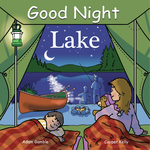
Good Night Lake

This is a fun board book and perfect companion to Up North at the Cabin for the youngest child. So, if travel includes a baby, bring this one along.  It takes the reader through a day of ducks and lily pads, frogs and fish. A summertime dock for friends who swim. Playing in the sand, hiking and looking for bugs. It even includes a day of ice fishing and a walk through autumn woods gleaming with red and gold leaves. And of course, every perfect day ends with a campfire.

Didn’t we have Fun! By Hilda Robinson and Jeff Kunkel. Crickhollow Books, Milwaukee, WI, 2012. Didn't we have fun

This book is a collaboration between artist, Hilda Robinson, and writer Jeff Kunkel. The jacket notes explain that, “Hilda’s work is featured each year in the Art of Living Black, an annual art exhibition at the Richmond Art Center in California.” Jeff Kunkel’s text is based on interviews he did with Hilda.  The final product is a lovely depiction of her memories of “…growing up in a close-knit, African-American neighborhood, long before television was invented.”

Hilda’s use of oil pastels gives an impressionistic quality to the paintings.  Little girls in freshly ironed dresses, black patent leather shoes and bows in their hair walk through a park on what must be a Sunday.  But oh, look. There’s one boy among them in a white suit.  Five girls and one boy, Hilda and her siblings, proceed all in a row past an elderly couple on the park bench.  Green trees in the background look like lime colored powder puffs.

On the next page we see her parents: “My mother…held her head high and let everyone know that her children were the best.” Mama is dressed in her Sunday coat, high heels and hat.  “My father…wore beautiful black suits, silk ties and a Panama Hat.”  He worked for the railroad and whenever he had spare time would go to the barber shop to talk baseball with the neighborhood men.

Page after page depicts a childhood summer filled with family and friends, listening to the radio or just sitting on the front porch if it was too hot to be inside. “Children played on the front steps and sidewalks.  Grownups sat in wooden rocking chairs on the front porches and kept an eye on the children. Everyone went ‘Oooo!’ and ‘Ahh!’ when a cool breeze came along.”  Children help with the laundry. Sheets and towels sway in the breeze on a clothesline while little girls play beneath them and mother visits with the neighborhood ladies.

The painting of six little girls, one holding tightly to a doll, playing hopscotch brought back memories for me.  The familiar squares in black with contrasting bright white chalk leap  off the page.  It will transport readers of a certain age back in time when recess was all about games and no one had a smart phone.

Roller-skating, basketball, swinging on swings and hanging from monkey bars depict play from a different time: when most free time was spent outdoors and little bodies got plenty of exercise.

I could go on and on.  The paintings are gorgeous and the accompanying text evokes a time and place that may be gone forever. But I hope not.

Posted in Uncategorized | Leave a comment

It seems like spring really is here this time. We had two days of 80 degree weather, which, really now, is summer, isn’t it?  But today it has cooled down to a more typical Wisconsin spring: overcast with a hint of rain in the air.  Who am I kidding? It’s 40 degrees and freezing cold out today.  My family in Northern Wisconsin had a foot of snow—on May 2. Over last weekend, however, my neighbors were out diligently working on their yards.  I went to a luncheon at the museum instead.  Had company on Sunday, and oh, almost forgot: suffered with an infected tooth all weekend. So I didn’t get any yard work done.  The tooth is better but I still have very little energy to pull weeds, mulch or plant.  Sitting on the porch one sunnier day I saw some bugle weed encroaching on my epimedium so I actually pulled a few strands of that.  It doesn’t take much physical energy though to read my favorite garden themed books for kids.  Getting off my duff and writing the reviews—that’s another story.  But here goes.

Hanna in the Time of the Tulips

Hana in the Time of the Tulips written by Deborah Noyes, illustrated by Bagram Ibatoulline,  Candlewick Press, Cambridge, Massachusetts, 2004. 

I planted 40 tulip bulbs two years ago.  They came up last year, stretching and reaching for the mottled sunlight our maple tree jealously hoards.  They were beautiful though, if a little bent in the sun’s direction.  We had tulips on the farm where I grew up.  Tulips and peonies, the latter’s sweet smell still brings me back to my childhood.  My blossoms are not as prolific or as large as those on the farm were, but they’ll do.

I first discovered Hana in the Time of the Tulips at a retreat of the Wisconsin chapter’s Society of Children’s Writers and Illustrators (SCBWI).  I knew I had to have the book.  Deborah Noyes was nice enough to sign it.  The story of “tulipomania” that swept through Holland in the 1600’s appealed to my history loving nature.  Ibatoulline’s acrylic gouache paintings appealed to my “Oh what gorgeous flowers” nature.  I am a sucker for flowers.

The story tells of a little girl who misses her father.  He has not gone anywhere. He is still at home, meeting with important men who smoke pipes and have serious expressions on their faces.  But he has been hypnotized by the riches that can be had buying, selling and trading tulips. He no longer plays games with Hana and when he kisses her goodnight, his mind is elsewhere. Father does not see the beauty of the flowers.
He sees only the profit to be made. But when the market for tulips crashes in 1637, Father is devastated. Hana devises a plan to cheer him up.

This lovely book will appeal to many ages.  The smallest toddler will delight in the vivid paintings. The five-year-old will likely empathize with Hana’s sadness about her father’s neglect.  Older children will understand the message that greed and riches are not the stuff of happiness. The back matter that explains the history of these bulbs which “…might have been onions wrapped in damp paper” will appeal to the adult reader.

This is, quite simply, a beautiful book.  Oh, and did I mention that the famous painter, Rembrandt, shows up as a character?  May all your tulips be as lush as Hana’s.

My Garden

My Garden by Kevin Henkes. Greenwillow Books, an imprint of HarperCollins Publishers, New York, NY, 2010. 

One day I walk into University Bookstore, head to the children’s section and whoa! Why are all these people here?  I look around and quickly realize Kevin Henkes is the honored guest and he is speaking to a large group of children and parents.  How did I miss the news that he was going to be here today? I immediately rush over to the picture book section.  Henkes doesn’t do that many appearances in his hometown so I’m not going to miss this chance to get one of his books, signed of course.

When I get to the Kevin Henkes collection My Garden immediately catches my eye.  It is not a book of his I’ve ever heard of, but the moment I set eyes upon that cover—a little girl with sunhat surrounded by flowers, butterflies and birds—I know this is the book I must have.  Did I mention that I’m a sucker for flowers?

It goes without saying that Kevin Henkes is a creative genius.  He writes and illustrates some of the most beloved children’s books such as Lily’s Plastic Purse and Wemberly Worried.  (Look for a review of the latter in the future.) I’m sure I’m not the only children’s writer that is jealous of him for embarking on his successful career at such a young age.  The story has been told how, when he was a University of Wisconsin student, he spent many hours at the Children’s Cooperative Book Center (CCBC) studying children’s books. Soon after he submitted a manuscript and portfolio to Greenwillow and the rest is history.  He has been fabulously successful and deservedly so.

My Garden is the kind of book, like all of Henke’s, that reflects a child’s interpretation of the world around her.  As a sometime teacher of kindergarteners, I know firsthand that young children look at the world with “new” eyes, and explore the world in a quest to satisfy their endless curiosity.

The main character of My Garden, like many children, helps her mother water and weed the garden. But if she had a garden, “There would be no weeds, and flowers would keep blooming and never die.” Just by thinking about it, she could change the colors of the flowers. She wouldn’t have to worry about rabbits eating the vegetables because all the rabbits would be chocolate and “I would eat them.”  No matter what she planted, such as sea shells or jelly beans, they would all come up in her garden.  Tomatoes would be huge and carrots invisible (because she doesn’t like carrots.)

Students of writing are advised to “show, don’t tell” meaning the author must use dialog (inner or with another character) or some other technique to transmit the scene in a satisfying way without the author’s voice interfering.   Henke’s ability to “show” the curious mind of a child never ceases to amaze me.  His simple watercolor and ink paintings enhance and compliment this goal of showing the reader the world from a child’s point of view.

Old Macdonald Had an Apartment House

Old MacDonald Had an Apartment House written by Judith Barrett and Illustrated by Ron Barrett. Atheneum, New York, NY, 1969. 

Long before the urban farm movement there was Judith and Ron Barrett’s Old MacDonald.  This is a hilarious book about two people living in an apartment house who really would rather be farmers. The man is the super.  His wife wishes she could grow vegetables, but her tomato plant in the window doesn’t get enough sun because there’s a hedge outside the window casting a shadow.

Except that I don’t live in an apartment, this could be the story of my futile efforts to grow vegetables when we first moved into our present house.  I gave our six mature maple trees little thought when I forged ahead optimistically planting squash, tomatoes and beans.  What a disappointment when the tomatoes didn’t set fruit, the beans were few and far between and the squash—well, besides being in the shade, a squash borer set up house and they were history. I switched to flowers.

Older children and adults are sure to get more than a few laughs out of this one. Old MacDonald decides to cut down the hedge that’s shading his wife’s tomato plant.  When the tomato does so much better, he cuts down all of the hedges. This is where the story takes a delightful turn into fantasy. When a lady moves out, MacDonald takes over her apartment and turns it into an indoor garden. Soon there are carrots growing through the ceiling of the downstairs apartment.  Sweet potato vines come out of the faucets. A cow moves in.  When the tenants move out in disgust Old MacDonald really doesn’t care.  He’s tired of being super. “He had begun to feel that in some ways vegetables made better tenants than people.  Carrots didn’t smudge brass doorknobs…And potatoes didn’t bang on the radiators for more steam.”

When the owner of the apartment finally shows up to check on his building, he’s horrified to find that his tenants have been replaced by plants and cows.  He orders MacDonald and his wife out.  But wait—maybe there’s a way vegetables can make him money.

This is a quirky book that will especially appeal to kids with a quirky sense of humor.  And the adults who love them will get more than a few laughs out of this one too.

A Gardener's Alphabet

A Gardener’s Alphabet written and Illustrated by Mary Azarian. Houghton Mifflin, Boston, MA, 2000. 

I came across this book while substitute teaching one day.  Whenever I have a break, I look over the books in the teacher’s room.  This one caught my eye with its brightly colored cover of a grandma and little girl.   They are surrounded by a flower garden brimming with color.  A comfortable Adirondack chair is waiting for when Grandma and grandchild need a short rest.  The young child is picking flowers, and a basketful of them sits next to her waiting for more.  The detail of this cover, done in woodcut and tinted with watercolors, draws in the reader before ever opening the book.  This garden looks real enough to enter.

Azarian explains in the front matter that she spent a lot of time around gardens as a girl.  Her grandmother had a large flower and vegetable garden and she lived with her uncle for a time who had a small market garden.  These childhood memories are reflected in the illustrations many of which show young children working alongside older adults in a variety of gardens.  And because this is an alphabet book many diverse types of gardens abound.  The most creative is definitely what Azarian calls a xeriscape: a garden that requires little water.  This particular one reminds me of a garden my husband and I experienced in Tucson. It was the landscaping around a wonderful little Bed and Breakfast.

The author’s love of working and playing in the garden comes through clearly in these illustrations.  For example, the M page stands for Manure.  A woman in red boots is shown spreading manure—her face is determined but still pleased to be working in her garden. The Q page stands for Queen Anne’s Lace and shows two girls surrounded by puffy white blossoms weaving crowns of wildflowers through their hair .  Even insects, the scourge of every gardener, get their own page. The I page is a delightful mix of colorful flowers and every kind of insect imaginable, not all of which are friendly toward plants.

This is the perfect time of year to read this book, curled up in an Adirondack chair with a young child–after which she can help dig in the mud. It’s what young children do best!


Posted on by stephanielowden | Leave a comment

Baseball, Bats and Bigotry

I just looked over my post from last time. It was snowing.  Guess what?  Snow was in the forecast again this week! So far, we’ve been lucky—if you consider it lucky to be in the midst of a cold snap just when the flowers are peering up above the ground.  Just a few days ago I watched the Brewers play at Wrigley Field.  Most players had knitted masks over their faces.  Long sleeves.  The fans were bundled up in parkas.  Time for more baseball book reviews.

Baseball Saved Us by Ken Mochizuki, illustrated by Dom Lee.  Lee & Low Books, New York, 1993. Baseball Saved Us

It was 1942 and the United States had just declared war on Japan.  The Army rounded up people of Japanese descent, removed them to the middle of the desert and put them into internment camps until 1945.  Our government justified this action by saying that they couldn’t know who among them would be loyal to Japan. None of these people were ever proven to be a danger.  This theme, fear of “the other,”is the theme of my own middle grade novel, Jingo Fever. In my novel the target of intolerance is German-Americans. Although they were not interred, many of them suffered from prejudice and abuse during the First World War and to a lesser extent during the second.

As the young narrator of Baseball Saved Us explains: “We weren’t in a camp that was fun, like summer camp…Soldiers with guns made sure we stayed there, and the man in the tower saw everything we did, no matter where we were.” Mochizuki’s parents were interred in such a camp. The first person voice conveys empathy and understanding that undoubtedly arises from stories his parents told.  The young boy explains how he was bullied in school before he came to camp.  He didn’t understand why all of a sudden people were so mean to him. One day his parents show up at school, rush home and explain how they have to give away many of their possessions.  At first they are kept in horse stalls until they relocate to the desert. Sitting idle all day and putting up with crying babies at night causes tempers to flare.   When his older brother shows disrespect toward their father, “That’s when Dad knew we needed baseball.”

The ingenuity of the adults is nothing short of amazing. They funnel water from an irrigation ditch to make the baseball field. “The water packed down the dust and made it hard.” Somehow, even though there were no trees, they find enough wood to make bleachers.  Bats, balls and gloves arrive in the mail from friends back home. The women make uniforms from mattress covers.

Dom Lee’s illustrations, some of which were inspired by Ansel Adams photos of the Manzanar camps, bring the grittiness of camp to life. Reading about the dust storms that blow through camp, readers will taste the sand in their throats. “We sometimes got caught outside, standing in line to eat or go to the bathroom.”

Although this is a story about a shameful time in American history, it’s also a familiar story of a young child, shorter and less athletic than the other kids, just trying to fit in.  Long before camp and Pearl Harbor, the boy’s classmates made fun of him for his lack of athleticism.  He’s shorter than the other kids.  Less skilled so no one picks him for their teams.  But the internment camp changes all that. He plays every day and develops real baseball skills.  He grows.  And when the war is over and he gets back to school, although he sometimes hears that word “Jap” thrown at him, he also proves he can play the game. Baseball Saved Us is, in that way, a timeless story with the universal theme of a child trying to fit in among his peers. But the history of that time should be a cautionary tale to us all. It is all too easy in a time of war to revert back to that “fear of the other.”

Bats at the Ballgame written and illustrated by Brian Lies. Houghton Mifflin, New York, 2010. Bats at the Ballgame

“Written and illustrated by…”  Every time I see those words on a picture book I am amazed and not a little bit envious of writers who can illustrate their own work. Someone like me, who can barely draw stick figures, fantasizes about painting evocative watercolors to accompany my picture book manuscripts. It’ll never happen.

Brian Lies’ fanciful bats are at it again.  This time the author of Bats at the Beach and Bats at the Library takes on baseball.  The bats hang out, literally, in the rafters of some old building waiting anxiously for the sun to go down.  “Restless wings begin to itch—excitements at a fever pitch. At last it’s time, and with a sigh, we hustle out to diamond sky.” Once the sun is down this group of bats fly off to the baseball park to face a team that “has beaten us in every fight.” When they reach the ball park, they are not unlike humans entering for the first game of the season. They are awestruck by the “brown so brown, green so green.”  Vendors call out, “Mothdogs, Get your mothdogs here!” or “Perhaps you’d like a Cricket Jack?”   Surely this is the time of year when many of us baseball fans, after hearing the National Anthem sung, feel that “Something changes with those words. We feel a magic shift, and ride the currents of the game as time is set adrift.”

This picture book is nothing short of an ode to the beginning of the baseball season.  But of course, that first game of the year may go horribly wrong.  When the other team gets the first run and our batters just can’t get it going, it’s time for stories.  “Grandbats” tell the youngsters about their heroes from the past.  This double page spread features famous ball players – in the form of bats of course – playing out their most celebrated moments in baseball.  See if you can guess who each of them represents.

And, like Casey at the Bat, when the umpire makes a call the home team disagrees with the crowd rains down vitriol upon the umpire. In this epic poem, however, the fans yell  “Fire the ump” rather than “kill.”

This book is just plain fun.  Children will enjoy the vibrant paintings of these lovable bats.  Adults will appreciate the rhyming style that makes this book an easy favorite to re-read over and over. A portion of the profits of the book is donated to Bat Conservation International.

Posted in Uncategorized | Leave a comment

Take Me Out to the Ballgame and Away from all this Snow!

It snowed again the other day: March 18. Alright already, enough! However, I know spring is nearly here, not just by the calendar, but by the fact that every day there’s a baseball story in the Sports section.  I was mildly interested in the World Baseball Classic, but let’s face it—the real season starts in April (except this year it’s March 31).  So, for this installment of children’s book reviews I’ve chosen two books with a baseball theme. They transport us back in time, when baseball was on the radio and night games were still in the future. Request them from your local library now so you can read them as the snow continues to fall outside your window.  These stories will be a sure reminder that indeed, spring is not far away. And that snow out your window will give way to green grass sooner than you think.

And don’t miss my next post which will review two more baseball books: Baseball Saved Us, a poignant portrayal of baseball played at Japanese internment camps during World War II and Bats at the Ballgame, another in the series of Bat (the kind that hang upside down) books by Brian Lies.

Casey at the Bat by Ernest Lawrence Thayer, illustrated by Gerald Fitzgerald.  Atheneum Books for Young Readers, New York, 1994.

 Casey at the BatI first read this poem when I was nine years old.  It was in an anthology of poems and short stories we had.  I remember sitting on my bed on the second floor of our farmhouse, paging through the thick book.  There were many stories in this treasure, the name of which I cannot remember.  “The Happy Journey to Trenton and Camden” I found boring.  “The Gift of the Magi” nearly broke my heart. I felt so sorry for the couple giving up their most prized possessions.  I didn’t get that it was a joyful story of young love.  I was nine after all.

But Casey stuck with me.  Maybe because the Milwaukee Braves were the background music of my childhood summers.  WTMJ, like today, carried every game.  In later years baseball would mean something more to me.  I remember my dad cheering on the Braves that summer of 1957 when they won the World Series. He died suddenly of a heart attack the following summer. That summer I was nine.

I don’t remember if I read “Casey at the Bat” before or after my father’s death.  I just remember reading it and feeling sad for Casey, a fictional character in a most familiar situation. This edition of the poem, with Fitzgerald’s acrylic paintings, evokes a time gone by.  The illustrations are dream-like, as if these were photographs taken a century ago with a soft-focus lens.  Perhaps this is why I find this interpretation of Casey so compelling.  For me this book brings back those memories of childhood—both joyful and sad. But all readers will find this book an enjoyable reflection to a time long past—when baseball was heard exclusively on the radio and the crowds cheering in the background had to come to the ballpark to watch a game. And it’s sure to warm up a snowy spring day with its lyricism and visual journey to a simpler time.

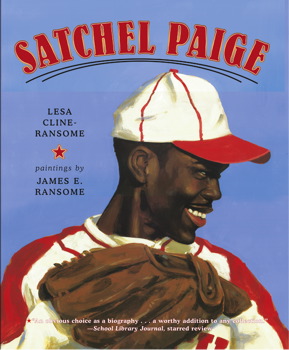
Satchel Paige by Lesa Cline-Ransome, paintings by James E. Ransome.  Simon & Schuster Books for Young Readers, New York, 2000. 

Satchel PaigeCommitted baseball fans, those who love the game and not just their team, already know who Leroy “Satchel” Paige was: first black pitcher in the major leagues; first black to pitch in a major league World Series; first black Baseball Hall of Fame inductee.  But everyone may not know that when his mom “…needed a plump chicken for the evening’s supper, she’d send her Leroy to do the fetching…with a rock he could knock a chicken…out with one shot.”

The casual baseball fan may not know that to earn some much-needed money, Satchel, the seventh of twelve Paige children, headed to the train depot and earned “shiny new dimes” from people whose luggage he carried.  And because he’d “hang a half-dozen or so” on a stick his friends called him “Satchel.”

But Leroy got into trouble.  Shortly after his twelfth birthday, he was caught stealing and was sent away to a reform school for Negro children.   School was difficult but hard work agreed with Leroy. And the school had a baseball team.  This team was nothing like how he’d played baseball in the streets of Mobile, Alabama.  This team had real balls and bats. Six years later he came home and got a position on the black semi-pro team the Mobile Tigers. It wasn’t much money but it was enough to put food on the table for his mom and siblings.

Ransome explains how the white major league players were treated differently from the Negro league players. Some nights the black players had to sleep on the ball field because no hotel would have them.  But this life suited Satchel. He would go on to play with some of the best Negro league players: “Cool Papa” Bell, Oscar Charleston and Josh Gibson.

Although Satchel’s pitching arm was legendary, his demeanor on the mound was just as commanding. James Ransom’s oil paintings with vibrant colors and contrasts reflect the bravado of Paige’s personality.  In a painting in which Satchel is a giant against a perfect blue sky, the author explains:  “He had an odd way of pitching. He would stand tall and straight as an oak tree…his foot looked to be about a mile long.” Crowds loved his easy confidence and style, including his banter on the mound. “Why don’t you all have a seat?” He’d call to the outfield, “Won’t be needing you on this one.”

Satchel Paige played in his last professional baseball game in 1966.  His actual birthdate is unknown but he would have been about 60 years old.

Posted in Uncategorized | Leave a comment

Poetry and Song: A Nod to the Dreamers

I titled this a Nod to the Dreamers because two books exhibit particularly creative approaches to poetry and one chronicles the roots and meaning of a well-known song. Poets are nothing if not dreamers.

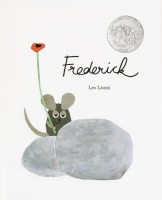
Frederick, written and illustrated by Leo Lionni.  Pantheon Books, a division of Random House, New York, 1967. Frederick

When the little field mice begin storing supplies away for the winter, Frederick seems to be too lazy to help. “Frederick, why don’t you work?” they ask.  “I do work…I gather sun rays for the cold dark winter days.”  And so, as the other mice work feverishly to prepare for winter, Frederick gathers colors—and words.  When winter finally comes and their supplies are running low, the field mice turn to Frederick for the gift only a poet can give.

Lionni’s illustrations will appeal to the youngest child, but the message will resonate with readers of all ages who were ever accused of being too much of a dreamer.  Writers and poets will recognize themselves in Frederick and rejoice when his mice friends credit him for the gift only he could give.

I own the Pinwheel paperback edition of Frederick.  It is dog-eared and well worn—proof of how many times I read it to both of my children.  Every time I re-read it, I’m reminded of the little girl who gazed out the window of her elementary school, day-dreaming, instead of paying attention to the task at hand.  This story will validate every budding poet and writer who, more often than not, feels as if their “gift” is a poor substitute for being the best mathematician or scientist in the class.  This one is for poets and dreamers of any age. 

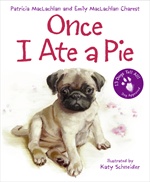
Once I Ate a Pie, by Patricia MacLachlan and Emily MacLachlan Charest; illustrated by Katy Schneider. Harper Collins, New York, 2006. 

Dog lovers young and old will delight in these expressive canines that Schneider’s paintings so expertly Once I Ate a Piedepict.  There’s Mr. Beefy, the bulldog, who, when he steals people food, likes to eat in private and did, indeed, once eat a pie. There’s Gus, the German Shepherd who wants his people in a group. “Like sheep,” he says. Then there’s Lucy, the shelter dog, who sleeps between her two owners.

The descriptive poetry by the MacLachlan’s that accompanies each dog is beautifully crafted. “Luke” is bound to bring a tear to the eye of anyone who owns an older dog.  “I dream about when I was young. I chased snowflakes in winter. And ran through the grasses in spring..…But now the sun is warm. And I sleep. And dream.”

When I saw this book on the shelf, I knew I had to buy it—for my adult daughter who owns two dogs.  It is indeed a book for all ages of dog lovers, but beware, the youngest child will undoubtedly want a puppy after experiencing the delightful canines in this book.  

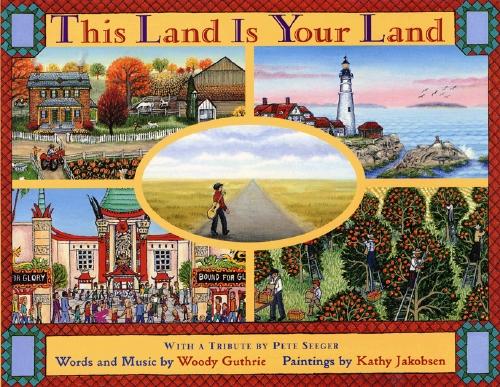
This Land Is Your Land, words and music by Woody Guthrie; Paintings by Kathy Jakobsen, with a tribute by Pete Seeger.  Little Brown and Company, 1998, New York. 

This familiar song never “looked” quite so beautiful.  Jakobsen’s paintings successfully depict the beauty of America, while at the same time illustrating the hard times Woody Guthrie sings about.  This edition includes all of Woody’s verses, some of which are conveniently overlooked when school children sing the song.  Those verses, though, are at the heart of what Woody Guthrie stood for.  The first page that illustrates a devastating time in our history is this one: “WThis land is your landhen the sun came shining, and I was strolling, And the wheat fields waving and the dust clouds rolling…”. The painting shows an idyllic farm with blue skies over head.  But look closer: in the distance is the black cloud of dust so familiar to farmers during the “dust bowl”.  Look even closer and the reader sees a farm wife running to her baby—who just moments ago was playing happily on a blanket outside—to get her indoors.  Father and son rush to the horses to get them in the barn and other family members point to the sky. A lot of history is told in that one double spread painting.

Another verse that is often skipped in elementary school, for obvious reasons, is this one: “As I went walking, I saw a sign there, And on the sign it said, ‘No trespassing.’ But on the other side it didn’t say nothing; That side was made for you and me.”

Woody goes on to describe the relief line of hungry people so common during the depression and asks: “Is this land made for you and me?”

As Woody goes walking that “…that freedom highway” another double page painting, shows a community center offering services such as day care, life skills classes and drug rehab.

The pages on which the familiar chorus is sung has intricate, detailed pictures children will love to pore over. The first chorus is accompanied by a full page painting of San FranciscoBay. The facing page—New York City with twin towers intact.

Another nice touch is the addition of tiny little squares, almost like post-it notes, that decorate the corners of many pages.  On these little notes are quotes from Woody, some playful like this one: “Left wing, chicken wing, it’s all the same to me.”  Others chronicle the dust bowl: “You could see the dust storm coming/ The cloud looked death–like black/ And through our mighty nation/ it left a dreadful track.”

This book is like a history book. Not the history of wars and battles, but the history of the people of this country: people struggling against nature, hunger and social systems deaf to their needs.  But it is also a celebration of the vast beauty of this nation with its redwoods and wheat fields, mountains and ocean shores.

Well, I could go on and on.  Just buy this one.  Do it.  Give it as a gift to yourself or a friend—of any age.  You’ll be glad you did.

Posted in Uncategorized | Leave a comment

Happy Birthday President Washington!

Who knew that George Washington was born on February 11, 1732 but that because eleven more days were added to the calendar in 1752 George’s birthday was celebrated on February 22.  What?  Eleven days were added to the calendar? Who did this–and why?   But that’s a subject for another day.  For now, let me suggest that instead of “President’s Day” we actually celebrate George’s birthday today: February 22.  The day he celebrated it after 1752.George Washington

George Washington’s Teeth, written by Deborah Chandra & Madeleine Comora, Pictures by Brock Cole. Farrar Strauss Giroux, New York, 2003

I had no idea that George Washington spent most of his life in pain from rotting teeth. Of all the books about Washington I found the quirky George Washington’s Teeth the most fascinating.  The rhyming text of this picture book is fun and skips along like a song.  The back story, revealed through letters and journals of Washington himself, which are the final pages of the book, show our first President suffering throughout his life with bad teeth.  This book is written for two age groups: the rhyming, playful text that young children listening will soon be able to memorize and the back pages that are a timeline of Washington’s life. For example, an excerpt from his letter to a friend, inquires about a dentist:  “ ‘…Having some teeth which give me a great deal of pain…’ He then crosses out the words ‘give me a great deal of pain’ and writes instead ‘are very troublesome to me at times.’”  Troublesome to say the least! In 1776, when Washington posed for Charles Winston Peale’s famous portrait, old root fragments embedded in George’s gums were causing him great pain.   Looking closely, one can see a scar on his left cheek from an abscessed tooth. In his later years dentures contribute to his deafness and constant gum infections are a factor in his death in 1799.

The younger child will enjoy the text and need not read the historical timeline in the back. But when older children discover how Washington suffered, the timeline can be an impetus for more study of what treating illness  was like over 200 years ago.  Today we fight over the issue of health care, but this information should give us all pause. Speaking as someone who suffered from an infected abscessed tooth, I couldn’t get to the dentist fast enough. I’m thankful I wasn’t born  when George was.

Posted in Uncategorized | Leave a comment

I know, I started out the New Year by committing to weekly book reviews.  I’m a little behind due to our vacation to the Everglades, which was, by the way, spectacular. But that’s for a future post.  Today, however, in honor of the birthday of our sixteenth President, I’m reviewing a particularly poetic book about Abraham Lincoln’s childhood.

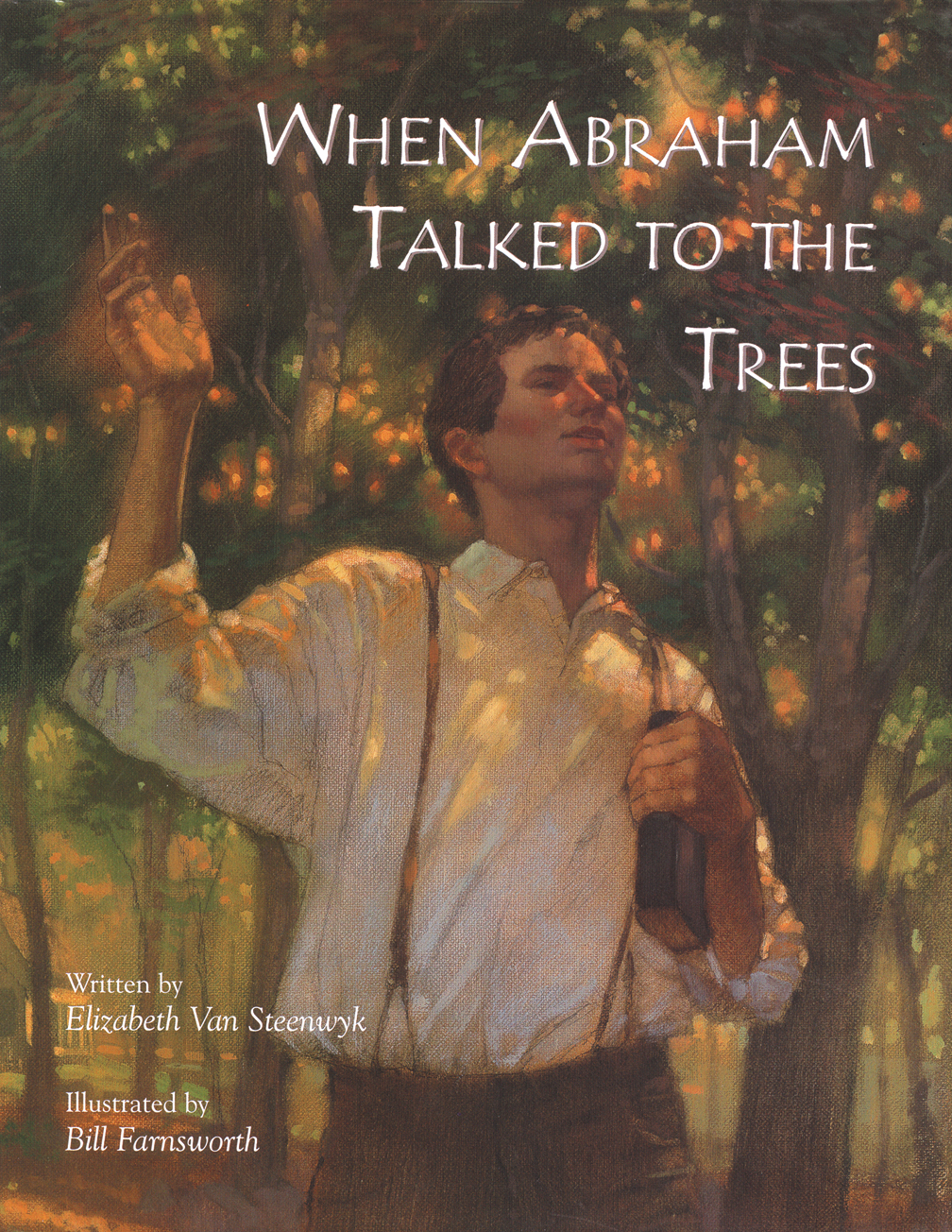
When Abraham Talked to the Trees, by Elizabeth Van Steenwyk, illustrated by Bill Farnsworth. Eerdman’s Books for Young Readers, Grand Rapids, Michigan, 20Abraham00. Ages 5 and up. 

This picture book, written in the vernacular of the rural South, illustrates that a young Abraham Lincoln learned to love books, writing and speaking during his boyhood, but it was far from easy. Farnsworth’s dream-like oil paintings depict a childhood filled with work and little time for study.  But Abraham found it.  Every night he read by candlelight, teaching himself to read, long after his sisters and brothers were asleep in their beds.  When Lincoln’s father is asked to build a church, “Abraham obliged his pa alongside a passel of other men as the church took shape against the sky.”  He watched and was impressed at how the preacher spoke.  “It came to Abraham then that there was more to talking than talking.”

Many children will identify with Abraham’s struggle learning to read: he didn’t even have a teacher.  As the author points out “school was a sometime thing.”  When young Abraham memorizes Aesop’s fables his family listens to his recitations with rapt attention.  But when they inevitably wander off, the young man continues, speaking to the trees, practicing the skill of oration that would serve him well during America’s troubled times.

I had the opportunity last spring to visit Lincoln’s library and museum in Springfield, Illinois.  There is a life-sized room there, much like the one pictured in this book, depicting a young Abraham Lincoln reading into the wee hours of the night.  His determination to read and later to speak with conviction was nurtured in these humble beginnings.  This book can be a vehicle to inspire the child who yearns to accomplish something difficult. The goal may not be President. It may be as life-changing as learning to read.  And Abraham struggling by candlelight can show the way.

Posted on by stephanielowden | Leave a comment

Celebrating Martin Luther King Day


In honor of Martin Luther King Day, I’m re-posting a review of three books that celebrate the history of African Americans and their struggle for civil rights.

“Rosa sat so Martin could walk. Martin walked so Barack could run. Barack ran so all our children could fly.” (Kiari Day)

Rosa by Nikki Giovanni, illustrated by Bryan Collier. Henry Holt & Company, New York, 2005

This story, along with CollierRosa’s evocative paintings, successfully depicts the heat and tension of the South in the 1950s.  Many of the details of Rosa’s simple, but powerful gesture, were new to me and will help inform children of today about a time in history when people of color did not have the same rights as white people.  It is a time we must never forget and this book explains, in Giovanni’s beautiful prose, how Rosa Parks started a movement by the very simple gesture of refusing to give up her seat on a bus.  The story will certainly shock children who’ve never heard it, and the details will undoubtedly enlighten many adults reading it.

The story of Rosa parks shows children how simple, seemingly small, courageous gestures can change history and even the world. And hopefully many of these young people will, in the future, learn to “fly.”

I’ve Seen the Promised Land by Walter Dean Myers, illustrated by Leonard Jenkins. Harper Collins Publishers Amistad, New York, 2004. Promised Land

This book starts and ends in 1968: the year of anti-war marches, civil unrest and assassinations.  Then, the story goes back in time to cover Rosa Parks and the bus boycott; Dr. King being arrested and his subsequent trip to India to study the non-violent civil disobedience techniques of Gandhi. King’s insistence that any action for justice remain non-violent did not sit well with some of his followers. But Myers stresses that this was an unshakable belief of Dr. King’s: that he would not hate those who hated him.

Children today are confronted with many situations that could lead to violence in school, on the playground and in their neighborhoods.  Martin Luther King can be a guiding light for kids who are impoverished, hungry and angry; kids who are bullied and want to fight back. King’s nonviolent message can be a beacon for those children shining a light on the possibility that small gestures can warm cold hearts and cool hot tempers.

Barack Obama, Son of Promise, Child of Hope, by Nikki Grimes, Illustrated by Bryan Collier. Simon & Schuster Books for Young Readers, New   York, 2008. 

“’Who’s that?’ David asks his mother, poiBarack Obamanting to the screen…. ‘That’s Barack Obama,’” she replies. This story within a story, beautifully written by distinguished poet, Nikki Grimes, not only tells of the hopes of Barack Obama, but of David’s hopes, the young boy listening to his mother. The mother in the story tells her son of the life of our 44th. President using a poetic cadence: “His family stretched from Kansas to Kenya, his mama, white as whipped cream, his daddy, black as ink.” When she tells David how important Barack’s grandparents were to him, the boy wishes his grandparents lived closer.  “Barry” grows up in Hawaii with kids of all different ethnicities.  And they all get along.   “Like the kids in my class” David replies.  When Mother tells him that Barry’s dad left when he was a little boy, David can relate. “I miss my dad too.”

The watercolor and collage illustrations, Collier explains “act as a metaphor for piecing different parts or issues together to make something new, whole or complete.”

This poetic picture book was published in June of 2008, before anyone knew if Obama would be our next President.  Its message should instill hope in every child’s heart who hears it and every parent who reads this outstanding story about a transformational, history-making figure of our time.


Posted in Uncategorized | 1 Comment

From Folklore to Picture Book-Three not to be Missed

This week’s reviews are of three retold folktales.  The first will appeal to even the youngest child while the other two are appropriate for ages five and up.

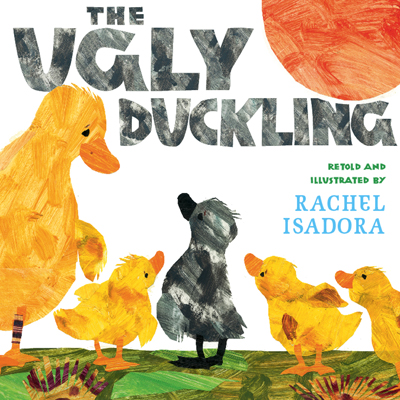
The Ugly Duckling: Retold and Illustrated by Rachel Isadora. G.P. Putnam’s Sons, 2009. 

Ugly Duckling The vibrant oil paintings of this version of Andersen’s tale evoke the African landscape and animals.  If your little one, (or you) have seen The Lion King these illustrations are sure to bring back memories of Simba and Rafiki.

Isadora, who lived in Africa over a ten year period, was inspired to retell common fairy tales in an African setting.  Everything from the tropical plants to the humans in this story is decked out in the most colorful finery I’ve seen in a children’s picture book. The youngest child will be fascinated by the colors.  Older children will delight in the story and appreciate the detail in the paintings, and parents will be glad to re-read this classic just to revel in the art one more time.

The Rough-Faced Girl by Rafe Martin, illustrations by David Shannon. G.P. Putnam’s Sons, New York, 1992. 

Rough Face GirlIn the Author’s Note, Rafe Martin says, “One way in which the universal yearning for justice has been kept alive is by the many tales of Cinderella.”  This is the story of three sisters: two—cruel and full of conceit; the third—a humble girl whose hard—hearted sisters force her to sit by the fire even as hot coals sizzle and pop onto her.  In their village is a large, beautiful wigwam in which lives the powerful and handsome Invisible Being. No one is able to see him except his sister.  The young maiden who proves she, too, can see him will be allowed to marry him.  The cruel sisters ask their poor father for all the buckskin and beads he has so they can dress up and try to win favor with the Invisible Being.  However, when they approach the sister who guards the Being’s wigwam, they are in for a nasty surprise.

This retelling of the Cinderella story is poignant and timely.  The Being’s sister can see not only outward beauty, but that which is inside the most humble.  It is a lesson for all time and certainly for today’s little girls who are surrounded by media that shouts a very different message.

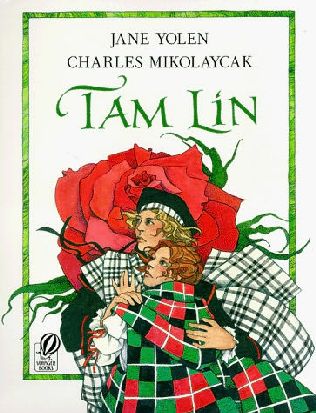
Tam Lin by Jane Yolen, Illustrated by Charles Mikolaycak. Harcourt Brace Jovanovich, New York, 1990. 

“DTam Lino not go down to Carterhaugh” the adults warn the children.  For Carterhaugh, once the property of the MacKenzie’s, now belongs to the Fairy Folk. But Jennet MacKenzie is a headstrong girl and determined to win back Carterhaugh for her clan.

This re-write of an ancient child ballad will remind many of Fairport Convention’s song by the same name. The determination of Jennet to free her castle from the Fey people and save Tam Lin’s life will surely appeal to determined young girls everywhere.  Definitely a picture book for the older child, Mikolaycak’s beautiful watercolor and pencil illustrations depict an ancient Scotland that is both terrifying and mysterious.  This one will appeal to all those lovers of magic, whether or not Scottish blood runs in their veins. 


Posted in Uncategorized | Leave a comment

Book Reviews Take Over Blog in 2013

I recently became a grandmother, so of course I have even more of an excuse to buy picture books than I had before.  Looking over my rather vast collection it occurred to me that I already own some lovely books other people may not have even heard about. So, I’m going to be using this space to write book reviews of those and other children’s books that may not be so well-known. I promise I will try to keep politics out of here. Note the word “try.” Sometimes I simply can’t help myself.

I made this decision in December and even though I tried to write a book review a month ago, Christmas and family took over my time.  So, for this first entry I am posting a lovely review by a guest reviewer. Kathy White says: “We lived in a Muslim country for 1 1/2 years, and still are learning about their faith.” She is also “a book-loving Grandma who wants to see all the good kid’s books coming along.  All of my work with kids over the years has been as a volunteer, including doing a preschool story hour in a public library in Appleton with a flannel board.  Does anyone even know what a flannel board is?”

Kathy White is a member of Madison Friends Meeting and spent one and a half years living in Saudi Arabia.

Muslem Child

Muslim Child, Understanding Islam Through Stories and Poems.   Written by Rukhsana Khan, Illustrated by Patty Gallinger, Sidebars by Irfan Alli.  Napoleon & Co.  Toronto, Canada, 1999; Albert Whitman, IL, 2002 

This is a beautiful book for school age children and their families to share.  Each chapter of this book is a story about one of the five pillars of Islam and the impact their faith has on the various details of daily life for these children.   I like using a story to help explain how things like not eating any pork products {one of the details which do impact their lives – think gelatin, for example} are sometimes very difficult to follow carefully.

Another nice feature about this introduction to Islam is that each story is placed in a different country, so one begins to realize that Islam is a faith in many parts of the world.  The sidebar details give the information that only 20 % of Muslims are Arab.  I think sharing this book, Muslim Child, will help change some of our assumptions about people who live according to Islam and help us draw nearer to them in understanding and compassion.

Guest Reviewer, Kathy White

Posted in Uncategorized | Leave a comment