Crenshaw, a “Harvey” for our time.

Crenshaw

Crenshaw, by Katherine Applegate, a Feiwel and Friends Book, imprint of Macmillan. New York, NY 2015.

Crenshaw is a cat. A very large cat. If you’ve seen the movie, “Harvey,” with James Stewart, you might call Crenshaw a pooka, a shape changer from Celtic lore. Originally, Crenshaw was Jackson’s imaginary friend, when Jackson was seven. But Jackson is going into fifth grade and he hasn’t seen his imaginary friend since, well, since his family had to live in their van. But that was years ago. Now Jackson hears whispers that his family might not be able to stay in their apartment. They’re only whispers, because his parents never tell him anything important. All they say is that they are going to have a huge garage sale, hoping to make enough money to pay the rent.

Jackson believes in science. He does not believe in imaginary friends. He thinks he has enough problems, trying to figure out his parents. “Sometimes I just wanted to be treated like a grown-up. I wanted to hear the truth, even if it wasn’t a happy truth. I understood things. I knew way more than they thought I did.” He’s afraid they will end up living in their van again.

When Crenshaw shows up, it’s the last straw. “I invented you when I was seven…and I can un-invent you now.” Jackson doesn’t need one more problem. When he pleads with Crenshaw to leave, the oversized cat explains: “Imaginary friends don’t come of their own volition. We are invited. We stay as long as we’re needed.” Jackson insists he did not invite him.

Crenshaw, the cat, is not thrilled to have to put up with the family dog, who senses the pooka, if he doesn’t actually see him. This is a wonderful book that hits all the right notes. It’s never too dark for middle grade readers and Crenshaw is pure delight as an opinionated cat with attitude. And doesn’t that sound like most cats you know? 

The story of Jackson’s family is a reflection of the times in which we live. As a substitute teacher, I know of children who live in their family car. I know of teachers who keep a stash of granola bars in their desks for kids who’ve missed breakfast. I know that attendance at the free breakfast programs in our schools has increased. But the homeless families, for whatever reason, get way less press than the homeless men who linger on street corners and make everyone nervous. Yes, that is a situation we need to come to grips with, especially the homeless who are mentally ill. But let’s not forget about the families who’ve become homeless, like Jackson’s, through no fault of their own. A major medical crisis or a lost job can send a family, already living paycheck to paycheck, spinning into a downward financial crash.

Like Jackson, we need to see the truth, even if it’s an unhappy truth, before we can solve the problems of homelessness and hunger. Let’s make sure these kids and their families can be seen, and like Crenshaw, remain seen until the problem is solved.

There have been food drives, inspired by the book Crenshaw, at bookstores all over the country. If you’d like to find out how you can do more to help kids, click on the link below.

http://www.mackidsbooks.com/crenshaw/index.html


Posted in Uncategorized | 3 Comments

Dia De Los Muertos a Joyous Celebration of Life

Dia de losMuertosDia De Los Muertos by Roseanne Greenfield Thong, pictures by Carles Ballesteros. Albert Whitman & Company, Chicago, IL. 2015.

I must admit, when I first learned of the holiday known as Day of the Dead, I was a little taken aback. Walking into a gift shop in Tucson some years ago and being greeted by an array of skeletons, I could only wonder, what was the appeal?

Then, ironically, a man who attends Quaker Meeting, where I am a member, introduced the holiday to our Sunday school children. He had made beautiful papel picado, cut paper banners, carefully carved with an exacto knife. I was told this holiday helps people remember their relatives who have passed on and is meant to be a joyous event.

Roseanne Greenfield Thong has certainly accomplished that goal. Carles Ballesteros’ illustrations exude all the joy and fun of the closely related holiday of Halloween. But Dia de los Muertos, rooted in pre-Christian tradition, is more closely allied to All Souls Day, the day Catholics remember their deceased loved ones. The Day of the Dead is about honoring and remembering those who’ve passed, and celebrating their lives in a joyous way. The children in the story gather gifts to adorn remembrance altars. Treats and mementos fill the altars in hopes of enticing the spirits of the dead to come back and visit for one night. Perhaps a picture of grandpa, “…who’s riding on horseback just like Pancho Villa!” Dollhouses and trains may be left out for small angelitos (children who’ve passed.)

The rhyming text keeps the story playful, not scary, and describes all the treats the children make for themselves—and their ancestors. “Sweet Calaveras, so sugary white—they give toothy smiles, but never a fright.”

The vibrant pastels and deep reds, blues and greens of the illustrations are a welcome relief to the ubiquitous orange and black colors of Halloween. There is a two page addendum explaining the holiday and a glossary assists in understanding the Spanish words. This is a beautiful book and has convinced this skeptic that the Day of the Dead is indeed a joyous and necessary holiday. I couldn’t help but think how this holiday could’ve served my needs as a child, when I lost my father at a young age. Although we remember our loved ones with sorrow, Dia de los Muertos reminds us of the happiness they brought into our lives. I am sure this story will spark fond memories in many children, as well as the adult readers. A very special book.


Posted in Uncategorized | Leave a comment

The Dress-Up Mirror a Spooky Choice for October Read-Aloud

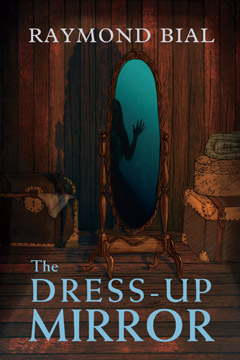
DressUoMirrorCover6x9.inddThe Dress-Up Mirror by Raymond Bial. Crispin Books, Milwaukee, WI. 2015

“On Friday night there were more noises, loud and frantic, throughout the night. Amanda heard muffled shrieks of ‘Murder! Murder!’and some sort of quarreling about a mirror. She looked around the dark bedroom, petrified. Amanda wanted to flee to her parents’ bedroom, but how weird would that be? She was thirteen.”

When Amanda’s mother brings home an antique mirror, Amanda persuades her to put it in the attic of their new home-a rambling Victorian with many passageways and closets.  Amanda, an aspiring fashion designer, keeps old clothing up there to mix and match, experimenting with different ensembles. After many nights of hearing noises and sleeping poorly, she convinces her mother that she should allow Amanda to have a sleep-over. She hopes not having to sleep in her room alone, and with two friends to distract her, she can forget about the creepy noises she keeps hearing. That night, the girls are impressed by the charm of the beautiful mirror. And then the trouble begins.

Raymond Bial has spun an exciting time travel story that keeps the reader wanting more. But it’s not just a mystery. Description of the historic details of the haunted house in the first chapter is reflective of the Victorian period to which Amanda and her friends will be thrown into in the following chapter. It is in 1912 that they learn all was not charming about this period in history. Immigrants were looked down upon. People were fighting for better working conditions, and prejudice was rampant. But once the girls are thrown back in time by the mysterious mirror, they must figure out why they have been brought to the exact same house in 1912.

The Dress-Up Mirror is a fast, fun read. Finally, even though the girls learn some ugly truths about our rapidly growing country at the turn of the last century, they also learn that most people are kind and want to help others.

Posted in Uncategorized | Leave a comment

Two Books that Reflect Turbulent Times in America

dust of edenDust of Eden, a novel by Mariko Nagai. Albert Whitman & Company, Park Ridge, IL. 2014

Thirteen-year-old Mina Tagawa is singing in Sunday school choir, practicing Silent Night, when a man crashes through the door, yelling,

“‘…the Japs bombed Pearl Harbor.’ The world stopped.”

Mina Tagawa has a best friend that she shares secrets with. She has a big brother with a room full of track trophies. She has a grandfather who raises roses. But suddenly, in December 1941, she has a new identity: enemy.

Dust of Eden is a powerful story, told simply in verse. The beautiful writing and simple lines belie the tragedy of the subject: for three years Mina and her family live behind barbed wire for no other reason than that they are of Japanese-American ancestry.

I am an American, I scream in my head.”

Mina wishes she could change her hair color to match Jamie’s, her best friend; change her name; change her parents. But of course she cannot. When they are told they must leave, there are two lists. A list of things they must take and a list of things they may not. Basho, their scruffy cat, must stay behind. Mina explains to Jamie, who will be taking care of him:

“He doesn’t understand English; he grew up around us, listening to Japanese. He doesn’t drink milk. He grew up drinking miso soup…”

At first it is a matter of putting up with classmates and others throwing that hated word, “Jap,” in her face. But once they are removed to an internment camp, there are more ordinary challenges in an extraordinary circumstance: how to take a shower. How to keep a dirt floor clean. But most of all, how to keep her father and brother from fighting.

Dust of Eden tells the story of one of America’s great shames. But it also tells the story of the ties that bind a family and friends,who remain true even when a prejudice tide sweeps away so many.

How I Discovered Poetry by Marilyn Nelson. Dial Books, New York, NY. 2014

Four-year-old Marilyn, sitting next to her mother in church, wonders why Lot had to flee from the bad city.

“imagine having a pet flea.”

“I giggle soundlessly, but Mama swats my leg, holding a finger to her lips.”

Written in unrhymed sonnets, How I discovered Poetry, is both a heartwarming and disturbing memoir. It is Marilyn Nelson’s story of growing up in the 1950’s, an African-American girl, daughter of one of the first African-American career officers in the Air Force. It is the story of a military family, moving many times, following her father’s transfers all over the States and constantly saying goodbye to friends.

Set against a travelogue of a military family, How I Discovered Poetry is also an exploration of the fifties: racism, the civil rights movement, bomb shelters and the beginning of women’s liberation. It also tells the story of a young girl coming to grips with what is happening in the South. She prays for the students in Little Rock. She recoils at the poem her teacher insists she read to the class, a poem filled with:

“…darkies, pickaninnies, disses and dats.”

But most of all, it is a poignant memoir of a young girl, coming to maturity and recording, in beautiful verse, her own history, so similar, but different, to the history of so many others.


Posted in Uncategorized | Leave a comment

The Way Home Looks Now

The Way Home Looks Now

The Way Home Looks Now by Wendy Wan-Long Shang. Scholastic Press, New York, NY, 2015.

When Peter’s brother, Nelson, is killed in a car accident, his family’s life is changed forever. Once a good student, Peter now forgets to put his name on papers and sometimes skips homework altogether. One day, he comes home to find his sister locked out. He panics, fearing his mother has locked her out on purpose. He runs to the back of the house, looks through the window and is comforted to see his mother sitting on the couch watching TV, like she has done every day since his brother died. Through the window, he sees his father arrive home and calmly walk into the house with his sister racing around him to check on Mom.

“If I could write my own TV show, Ba would hurry inside. He would know that something is wrong when Elaine is locked out. And he wouldn’t act like Mom watching TV all day is normal. I wonder how it is that he can see so little when I see so much.”

Peter knows something is wrong with is mother, but he has no name for it. He makes sure to get the mail everyday so Mom doesn’t see they are still getting things addressed to Nelson. His life revolves around the impossible goal that he has to protect his mother and make her better. His father seems to not notice his mother’s behavior, simply saying, “Leave your mother alone, Peter. She is tired.”

Peter is a twelve-year-old boy struggling with the death of his brother and the emotional breakdown of his mother. His father is distant and seems to only be interested in Peter getting good grades. He avoids his old friends and classmates. Soon they stop coming around, except for Sean, who was more of an acquaintance. But all Sean wants to do is play baseball. Peter can’t bring himself to do that, because Nelson taught Peter everything he knew about baseball, and Nelson is gone. Baseball evokes too many memories.

One day, for just a brief moment, Peter and his mother share a memory about when they went to the Little League World Series. This leads Peter to make a decision. He will play baseball again. And he gets the surprise of his life when Ba volunteers to coach.

This story is both heart wrenching and joyous. No, his mother is not cured of her depression by the end of the book. But Peter’s father explains that as in baseball, sometimes you just have to be patient. When your team has a bad year, there’s always next year. Be patient and they will win again.

“As long as I have waited for Mom, I must wait some more, even when it’s the last thing I want to do.”

This story resonated with me for two reasons. The first is my memories of baseball. The ’57 Milwaukee Braves, who won the World Series that year, are a bittersweet memory for me. I was only eight years old the summer of 1957 and Dad was a big fan of the Braves. Earl Gillespie’s radio broadcasts were background music in those days. That was the year I learned what a pennant race was. All the names of the players, Hank Aaron, Johnny Logan, Warren Spahn, or Spahnny as Dad and everyone else called him, were like guests in our farmhouse. I see that summer now through a soft focused lens. I was the luckiest little girl in the world, who had my own horse, wild strawberries to pick and long, summer days with nothing to do but wander the farm fields and daydream. Could it have been that perfect?

This brings me to the second reason this story resonates with me. Only one short year later, my father would be dead of a heart attack. We would no longer live on the farm. The horses would be sold. The radio, eerily quiet. After my father died, my mother also went through a depression, although not as severe as Peter’s mother. But I recognized that same emotional disconnect, even if Mom didn’t sit on the couch all day watching TV.

Baseball, and my parents, are emotionally interwoven in my heart. Mom eventually became a Brewers fan and listened to Bob Uecker’s broadcasts until she passed away. As a teenager, I forgot about baseball. Many years later, when I had kids of my own we went to see the movie, Field of Dreams: a story about a man who reconnects with his dead father through baseball. I was a puddle of tears by the end. I started listening to those radio broadcasts again. Baseball has saved me on my darkest days, but not only me. A few years ago I read Baseball Saved Us by Ken Mochizuki. It tells the story of Japanese men and boys who started teams while living in the World War Two internment camps. As one internee at Manzanar, Takeo Suo, recalled, “Putting on a baseball uniform was like wearing the American flag.” Even Walt Whitman thought baseball could bind up our wounds after the Civil War. “…anything which will repair such losses may be regarded as a blessing to the race.”

Oh, and about that World Series win of 1957? Some years ago, I went to a Mallards game at which Johnny Logan was signing autographs. When it was my turn, I told him I remembered the 1957 World Series and that my dad was a big baseball fan. Then I told him Dad died the following year. Johnny Logan looked at me said, “I’m so sorry,” and handed me his World Series ring. “Here, take a look at it.” It’s a moment I’ll never forget.

Posted in Uncategorized | Leave a comment

Doyli to the Rescue Saving Baby Monkeys in the Amazon

Doyli two

Doyli to the Rescue, Saving Baby Monkeys in the Amazon. Photos and text by Cathleen Burnham. Crickhollow Books, Milwaukee, WI 2015.

“The Yagua Indian man crept through the Amazon rain forest…hunting a family of red howler monkeys. If he was successful, his family would eat meat that day. If not, they would go hungry.”

When Cathleen Burnham’s family took a vacation in the Amazon, it was just the beginning of a longer story about how kids can save a little part of the world. As her family traveled down the Amazon River, Burnham spotted a hut surrounded by playful monkeys. When the tour guide told them “The family that lives there takes in orphaned…monkeys,” she begged to visit. Once there, they met Doyli, a ten-year old girl, who helps save baby monkeys and release them back into the wild.

How the three stories of the Yagua, the American and the young girl intersect gives the reader a fascinating look into the lives of the people of the Amazon rain forest. Doyli lives in Peru, as does the hunter. He must feed his family, but when he kills a mother monkey he finds a baby left behind. He takes the youngster to Doyli, knowing that the young girl will feed and shelter the baby until he is old enough to be set free.

Burnham does not judge the Yagua hunter. He must feed his family, that is a given. But he understands that when a mother monkey is killed and a baby left behind, the cycle of life must be protected. He knows that with Doyli, there is shelter for the young monkey.

There is, however, a dark side to the story. One day, Doyli and her uncle visit the public market, where Doyli spots a man selling a baby monkey. She knows that thieves kill monkey parents and then take the babies to sell at the market. Doyli tells her uncle and he informs the police. The man is arrested and the baby he was trying to sell is given to Doyli to be cared for.

This is a beautifully photographed book with an important story that shows readers you don’t have to be a grown-up to make a difference. In the author’s note, Burnham explains that there is an organization, the World Association of Kids and Animals (WAKA), that shares the stories of children, like Doyli, who are helping to protect animals all over the world. Burnham says she’s interviewed many children with stories similar to Doyli. I look forward to reading those stories in the near future.

For more information about WAKA visit www.WAKABooks.org

Posted in Uncategorized | Leave a comment

The Darkest Part of the Forest another Winner for Holly Black

The Darkest Part of the Forest by Holly Black. Little, Brown and Company, New York, NY, 2015. Young Adult.The Darkest Part of the Forest

As a writer of fantasy, I struggle with creating a world in which the reader can eagerly suspend her disbelief. In The Darkest Park of the Forest, Holly Black has successfully created such a world. To the casual observer passing through town, Fairfold seems like just another small town with ordinary houses and stores. Very few people casually pass through Fairfold, however. Tourists visit to see for themselves the glass coffin. Sometimes the visitors never return home. Those inhabitants who live here know better than to anger the Folk that dwell in the forest.

“Down a path worn into the woods, past a stream and a hollowed out log full of pill bugs and termites, was a glass coffin. It rested right on the ground, and in it slept a boy with horns on his head and ears as pointed as knives.”

When reading this book, I easily suspended my disbelief. Of course, the woods are home to the land of Faerie. Of course, the rest of the town is perfectly normal: small shops and modest homes. A town so small, the school holds all grades, K-12.

Growing up, Hazel and her brother, Ben, told stories to the boy in the coffin, had life-threatening adventures in the woods and hoped the boy would awaken someday. Hazel, now seventeen, visits the boy with the rest of the senior class, bringing not a charm to awaken the prince, but beer and I-pods. Drunken girls dance on top of the coffin. Still, the Folk and the inhabitants of Fairfold generally get along in an uneasy peace.

Hazel has a habit of kissing lots of boys while not caring for any of them. “Hazel kissed boys for many reasons…” but one reason was “…because she wasn’t sure how many kisses she had left.” When the boy in the glass coffin finally does awaken, Hazel wonders if a bargain she made with the Folk years before will now come due.

The Darkest Part of the Forest is not just an ordinary fantasy “page turner.” Black explores issues that face all teens: love, making good choices and figuring out whom one is. Hazel has many secrets. Her dysfunctional family is no small part of her life and has caused her to be selfish with her feelings, keeping them hidden. As a child, she imagined herself as a great knight who would some day free the boy in the coffin and save Fairfold from the monster in the woods. At the same time, she traverses normal teenage life with its temptations, grand emotions and life decisions that must be made.

This is a fantasy with complex characters and an equally complex dilemma. Holly Black’s world is so believable that you may be reluctant to leave Fairfold.

For myself, I will now go back to my work in progress and try to tackle my own world building challenge. And the next time I venture into the woods near my house, I will keep a wary eye out for the Folk.

Posted in Uncategorized | Leave a comment

Double Exposure an Important Book for Teens

Double ExposureDouble Exposure by Bridget Birdsall. Sky Pony Press, New York, NY. 10018, 2014.

Alyx Atlas is fifteen, loves basketball and is moving to a new city. She is also an intersex person who desperately wants to hide her secret. Hoping for a fresh start in a new city, Alyx can’t shake what she calls “daymares” or memories of the past she just left behind:

“Part of me stands on the porch shaking; the other part is back there—again. Choking on blood, the sharp edges of my braces tearing the flesh inside my cheeks, my body folding in on itself. The convenience store door flying open and it’s Rafi, the owner, with fear in his voice. ‘You boys! I call police!’”

Back in California, Alyx grew up “being a boy” while knowing in her heart she was a girl. She was teased mercilessly for being a boy who wasn’t quite “all boy.” Having self-identified as a female from a young age, she had passed for a boy because her parents opted not to have her undergo surgery until she could make that decision herself. After being beaten up yet again, she asks her mother why her parents just didn’t “make me a girl” when she was born? That’s what parents used to do. She suspects that “Dad would’ve rather had a half-boy than a whole girl, right?” Her mother denies that, but her father has passed away, so Alyx will never know for sure. All she knows for sure is that she needs a fresh start in a place where she can be herself. Together, she and her mom decide not to tell her new school anything of her past. She uses a new last name. Now, she passes as a girl.

Living in Milwaukee with her mom’s family, she is determined to finally be the girl she always felt she was. She joins the girl’s basketball team and, from day one, it’s obvious she’s a great player. But another girl on the team, Pepper, has problems of her own. Pepper’s insecurity and jealousy cause her to do some digging into Alyx’s past. When Pepper posts an old picture of Alyx on the internet and the caption identifies Alyx as a boy, the whole basketball team’s chances for a state title are thrown into chaos.

Full disclosure: Growing up in a farm community, I lived a relatively sheltered life. Then when I was in my early twenties, I visited a photography exhibit of Diane Arbus’s work. It was the early 1970s. My first introduction to people called “hermaphrodites” was through that photo exhibit. I had never heard of this “condition.” Around the same time I learned of transgender people. The LGBT (now sometimes referred to as LGBTQIA) movement became well-known. But I never thought much about folks like Alyx, until I read this book.

This is a story of the power of love, friendship and being true to oneself. It helped me better understand the experiences and trauma intersex young people go through. It should be required reading for school teachers and administrators to better understand the needs of all students, even if those needs seem “odd” or “too different.”

Let me be clear. Everyone who cares about kids should read this book. But the most important audience for it are kids like Alyx who’ve suffered their own bullying and just want to be, as Alyx says, “Just like Dad. Dead. Dead. Dead.” Alyx’s story will give them hope and strength to know, that indeed, being true to yourself can make the slogan “it gets better” a reality. Bridget Birdsall has written an important book. But it is also a real page turner. Don’t miss it.

Posted in Uncategorized | Leave a comment

Little Baby Buttercup Perfectly Depicts a Toddler’s World

Little Baby ButtercupLittle Baby Buttercup by Linda Ashman, illustrations by You Byun. Nancy Paulsen Books, an imprint of Penguin Group (USA) New York, NY, 2015. 

I was completely enchanted by Little Baby Buttercup. There are a whole array of books that portray a day in the life of a toddler and in that respect, Linda Ashman covers a wide range of typical activities: Mama cuddling her toddler girl; having breakfast (“Hand, mouth, cheek, hair–some to eat, some to wear.”);  building and toppling blocks; playing with the dog and a visit to the park that  includes a tumble, a bandage  and a kiss.

Where this story excels is the bittersweet tone. The jacket flap copy describes early childhood  as “fleeting” and as the reader follows Buttercup through her day it’s apparent that this time — and these experiences will too soon evolve into different, growing up, experiences.

I’ve been working on my own picture book manuscript and I’ve heard from editors that the ending of a good picture book must carry an emotional punch.  The final illustrations of Buttercup show the little girl learning new skills. Mama’s final line will have grandparents, if not parents, choking up. When I was a young mother with two young children every day was busy to the fullest. I’m not sure I fully appreciated how fast time goes and how quickly these little ones grow up. Now, taking care of my granddaughter, I want to tell time to please stand still! Linda Ashman’s rhyming text, and You Byun’s playful illustrations of a toddler girl pack that emotional punch at the end of the story for this grandma.   I, too, am lucky to be able to spend this fleeting time with a certain little girl.


Posted in Uncategorized | Leave a comment

Three books for Celebrating Martin Luther King Day


In honor of Martin Luther King Day, I’m re-posting a review of three books that celebrate the history of African Americans and their struggle for civil rights.

“Rosa sat so Martin could walk. Martin walked so Barack could run. Barack ran so all our children could fly.” (Kiari Day)

Rosa by Nikki Giovanni, illustrated by Bryan Collier. Henry Holt & Company, New York, 2005

This story, along with CollierRosa’s evocative paintings, successfully depicts the heat and tension of the South in the 1950s.  Many of the details of Rosa’s simple, but powerful gesture, were new to me and will help inform children of today about a time in history when people of color did not have the same rights as white people.  It is a time we must never forget and this book explains, in Giovanni’s beautiful prose, how Rosa Parks started a movement by the very simple gesture of refusing to give up her seat on a bus.  The story will certainly shock children who’ve never heard it, and the details will undoubtedly enlighten many adults reading it.

The story of Rosa parks shows children how simple, seemingly small, courageous gestures can change history and even the world. And hopefully many of these young people will, in the future, learn to “fly.”

I’ve Seen the Promised Land by Walter Dean Myers, illustrated by Leonard Jenkins. Harper Collins Publishers Amistad, New York, 2004. Promised Land

This book starts and ends in 1968: the year of anti-war marches, civil unrest and assassinations.  Then, the story goes back in time to cover Rosa Parks and the bus boycott; Dr. King being arrested and his subsequent trip to India to study the non-violent civil disobedience techniques of Gandhi. King’s insistence that any action for justice remain non-violent did not sit well with some of his followers. But Myers stresses that this was an unshakable belief of Dr. King’s: that he would not hate those who hated him.

Children today are confronted with many situations that could lead to violence in school, on the playground and in their neighborhoods.  Martin Luther King can be a guiding light for kids who are impoverished, hungry and angry; kids who are bullied and want to fight back. King’s nonviolent message can be a beacon for those children shining a light on the possibility that small gestures can warm cold hearts and cool hot tempers.

Barack Obama, Son of Promise, Child of Hope, by Nikki Grimes, Illustrated by Bryan Collier. Simon & Schuster Books for Young Readers, New   York, 2008. 

“’Who’s that?’ David asks his mother, poiBarack Obamanting to the screen…. ‘That’s Barack Obama,’” she replies. This story within a story, beautifully written by distinguished poet, Nikki Grimes, not only tells of the hopes of Barack Obama, but of David’s hopes, the young boy listening to his mother. The mother in the story tells her son of the life of our 44th. President using a poetic cadence: “His family stretched from Kansas to Kenya, his mama, white as whipped cream, his daddy, black as ink.” When she tells David how important Barack’s grandparents were to him, the boy wishes his grandparents lived closer.  “Barry” grows up in Hawaii with kids of all different ethnicities.  And they all get along.   “Like the kids in my class” David replies.  When Mother tells him that Barry’s dad left when he was a little boy, David can relate. “I miss my dad too.”

The watercolor and collage illustrations, Collier explains “act as a metaphor for piecing different parts or issues together to make something new, whole or complete.”

This poetic picture book was published in June of 2008, before anyone knew if Obama would be our next President.  Its message should instill hope in every child’s heart who hears it and every parent who reads this outstanding story about a transformational, history-making figure of our time.


Posted in Uncategorized | Leave a comment