“Yes Virginia, there is…World Peace”

(This essay originally appeared in the December 1990 issue of Friends Journal, a Quaker publication. Always the editor, I have made a few minor changes.)World_And_Peace_Doves[1]

Last Christmas, I read an article headlined, “Is Nothing Sacred? Holiday Symbols under Fire.” It was just one of many similar articles surfacing in these contemporary times that dealt with the issue of differing beliefs during the holiday season.  However, this particular article struck me in a way most others did not because the story was right out of the 1947 movie Miracle on 34th Street. A little girl, whose mother had told her there was no Santa Claus, was telling fellow kindergarteners that the old gentleman didn’t exist. The teacher overheard her and asked her not to tell the other children because it was upsetting them. The child’s mother pulled the girl out of school on the grounds that her free speech was being compromised.

When I read the article I couldn’t help but wonder if the child would meet up with Kris Kringle and he would set her straight.  However, that was just a movie, and today’s pluralistic society is more complex than it was in the 1930s. We have among us immigrants from many countries with as many beliefs.  We need to be sensitive to those beliefs at Christmas time as well as throughout the year.

That said, I couldn’t help but feel sorry for this particular little girl.  Nowhere in the article did it say her mother practiced a religion that demanded non-belief in Santa Claus. Instead I saw something of myself and my generation in this woman’s non-belief.

Many of us who came of age in the 1960s vowed never to mislead our children with tales of fairies or elves. We were rebels and we questioned everything. Fairy tales were sexist, violent, or both and were to be avoided. Santa Claus, if discussed at all, was “just a story,” as this little girl’s mother explained to her. Children were taught to believe in what they could see—what could be proven to be true.

I raised my first child with many of these attitudes, and then promptly disposed of them with my second.  Why? It was when I was expecting my second child that I began a spiritual journey that led me to the Society of Friends. Along with my spiritual journey, I realized what I’d always suspected as a child, but had denied as a young adult, that some things worth believing in couldn’t be seen.  It was around that time in my life that I read in its entirety Francis P. Church’s memorable reply to the eight-year-old girl who asked if there were a Santa Claus. I knew in my heart he was correct when he pointed out that just because we can’t see fairies dancing on the lawn doesn’t mean they are not there.

Today I realize that reading fairy tales to my children and letting them at least pretend to believe in Santa—just a little while longer—serves another purpose as well. It gives them the ability to believe in things that are not but could be.  Many Friends speak of “envisioning peace,” and in today’s world this requires quite an imagination.  If we can envision peace in our future, we can have peace in our future. If we don’t have the imagination to be able to see peace that does not now exist we will be ill-equipped to make peace a reality.  Perhaps if our children are taught to believe in things that are not “real” but have worth—the Spirit of Christmas after all does exist, even if Santa technically does not—they will be able to not only envision world peace someday, but actually bring it about.

There is a fine line between sentimentality and honest emotion. Some might say that 1947 movie suffered from an overdose of the former.  I would suggest many children today suffer instead from an overdose of seriousness that blocks their ability to feel the latter. Friends are as guilty as any for fostering this seriousness—maybe more so—with our talk of world suffering and possible nuclear holocaust in our First-Day School classes.  It is in childhood, after all, when we learn to dream the impossible. As adults we need to tread lightly so as not to extinguish that ability in our children.

December, 1990

Addendum: I’ve been writing fantasy ever since!

Posted in Uncategorized | Leave a comment

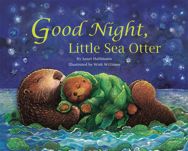
Good Night, Little Sea Otter: the perfect bedtime book

Good Night Little Sea OtterGood Night, Little Sea Otter by Janet Halfmann, illustrated by Wish Williams. Star Bright Books, New York, NY, 2010. 

“As the setting sun kissed the kelp forest, Little Sea Otter snuggled on Mama’s chest. Mama fluffed his fur until he looked like a brown powder puff.” It’s time for bed, but Little Sea Otter has other ideas.  He has forgotten to say goodnight to a variety of other sea creatures.  Just like a human child, he tries to put off bedtime.  Halfmann’s musical prose is so perfect that adults will have no reluctance reading and re-reading this delightful picture book. Little Sea Otter waves his “soft, silky paw” and dips his “furry face into the chilly water.” Fish “bubble and burble.” Mama finally wraps up baby sea otter, much like a human Mama would do.  And the little otter, much a like a human toddler would do, finds just one more creature to say goodnight to before nodding off.  Wish William’s illustrations depict the mother/child relationship so perfectly the reader will forget these are otters and not humans.  This is the perfect quiet book to read at bedtime, when settling down into the child’s own comforting snuggle place.

Posted in Uncategorized | 1 Comment

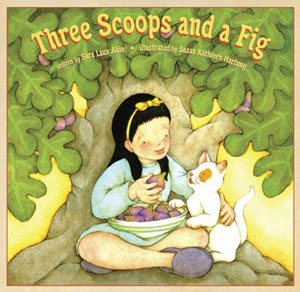
Three Scoops and a Fig as Delicious as a Cup of Gelato

Three Scoops and a FigThree Scoops and a Fig by Sara Laux Akin, illustrated by Susan Kathleen Hartung. Peachtree, Atlanta Georgia, 2010. 

Poor Sophia.  When her Nonno and Nonna are expected to visit her family’s Italian Restaurant, The Fig Tree, Sophia wants to help get ready for their visit.  But every “helpful” thing she tries ends up in disaster. She presses the button on the blender and causes an explosion. She puts too much yeast in the bread dough. She tosses pizza dough so high it gets caught in the ceiling fan. The adults around her tell her, “Bambina, sei troppo piccolo!” To which she replies, “I am not too little.”

But all is not lost. A chance encounter with a fig tree helps Sophia invent a new dessert just in time for her grandparent’s arrival.

Laux Akin’s spare but effective prose and Hartung’s watercolor illustrations bring Sophia’s Italian family to life. The story will resonate with any young child who wants to be grown up and help, but is told “you are too little to help!” The satisfying ending will reassure her that, like Sophia, her time to help will come.

Posted in Uncategorized | Leave a comment

Picture Books for Holiday Giving

I’ll be posting more reviews every couple of days in order to give my readers ideas for Holiday gift giving. I’m starting out with two lovely picture books that encapsulate that delightful time in the life of our children between toddler hood and preschool.

Sophie’s Squash by Pat Zietlow Miller, illustrated by Anne Wilsdorf. Schwartz & Wade. New York, NY, 2013.  Sophie's Squash

Ok. I have to admit I love squash. And I enjoy gardening. But even dyed in the wool vegetable haters will be captivated by Sophie and her squash friend, Bernice. Sophie and her parents go to the farm market one day and pick out a perfect butternut squash. “Her parents planned to serve it for supper, but Sophie had other ideas.” It turns out that the squash was “…just the right size to hold in her arms…bounce on her knee” and “to love.”  So Sophie draws a face on the squash and wraps it in a blanket.  When suppertime comes Sophie tells her mom, “I call her Bernice.” Mom decides on pizza.

This delightful book follows Sophie and Bernice as they go to the library, do somersaults and visit other squash at the farm market.  Every night she gives “…Bernice a bottle, a hug, and a kiss.” Her parents console themselves:  “Well, we did hope she’d love vegetables.”

But the life of a squash is short-lived. Inevitably, they become mushy. The way in which  Zietlow Miller leads Sophie to come to learn about the life cycle of a vegetable is endearing. Wilsdorf’s evocative watercolor and ink illustrations beautifully contribute to the satisfying resolution of Bernice’s life.  Finally, Sophie’s Squash is not just a sweet little story, but an avenue into a conversation about the circle of life itself.

Baby Says “Moo” by JoAnn Early Macken, illustrated by David Walker. Disney Hyperion Books. New York, NY, 2011. Baby Says Moo

“Baby rolls along grabs a yummy snack, waves at people and they all wave back. Baby, what do people say? Baby says ‘Moo’.” This delightful rhyme is accompanied by illustrations of a mother and father pushing their baby in a cart through a grocery store. 

My one-year-old granddaughter has several words. She definitely knows what she is talking about, but the rest of us have to try to figure out her increasingly long conversations. She clearly says dog and duck. But then there’s another word that sounds like dog that seems to mean a lot of different things. So when I read Baby Says “Moo,” which is about a young child who uses the same word for a variety of animals, I easily saw my granddaughter in the main character.  Looking closely at the illustrations, the reader will realize why the baby calls everything “moo.” I won’t give that part away. But what is so special about this book is that it illustrates that sweet and hilarious time when babies are just learning to talk and have a vocabulary all their own.

Early Macken’s rhyming lyrics accompanied by Walker’s acrylic paintings are sure to enchant any small child as well as their parents.


Posted in Uncategorized | Leave a comment

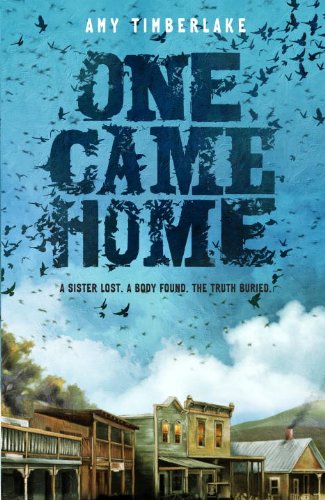
Nineteenth Century Mystery Entertains

One Came HomeOne Came Home by Amy Timberlake. Alfred A. Knopf, 2013. New   York, NY. 

So it comes to this, I remember thinking on Wednesday, June 7, 1871. The date sticks in my mind because it was the day of my sister’s first funeral and I knew it wasn’t her last—which is why I left. That’s the long and short of it.”

And so begins the mystery of Agatha’s death. Or not. Amy Timberlake’s One Came Home will keep you guessing from the first page to the last.  And while reading the story that unfolds, you will be treated to the voice of the protagonist, Georgie, one of the strongest female characters I’ve encountered in middle grade fiction.  Georgie is not convinced that the body found in her sister Agatha’s green dress, is indeed her sister.  The poor girl was shot in the face and it’s impossible to make a definitive identification in 1871.  But Georgie’s mother and grandfather are convinced because the dead girl is wearing the beautiful dress Georgie’s mother made.

Thirteen-year-old Georgie is sure her sister could take care of herself, even though she ran off with pigeoners—people who make a living killing passenger pigeons. Why she ran off is of particular interest to Georgie, because she feels it was all her fault. Guilt spurs her on to also leave town and find an answer once and for all if the girl in the green dress was her older sister. But first she needs to make plans.  Reading The Prairie Traveler: A Hand-Book for Overland Expeditions, Georgie meticulously makes plans.  The fact that her family owns a general store comes in handy when deciding what to take:

“My plan was to take what we sold in the store. Now, I knew that was stealing. Let’s not beat around the bush about what God thinks of taking without asking. But I’d mitigate the hurt by admitting to it. I’d write out an IOU and leave it in the account book.”

Besides the page turning mystery, the reader will see, and I dare say, almost smell, what it was like when Wisconsin skies were black with passenger pigeons and folks had a mess to clean up after the flocks passed over their town. Timberlake’s descriptive prose puts the reader in the middle of it all.

Georgie’s journey to search for answers to her sister’s disappearance takes many twists and even dangerous turns.  When Billy, her sister’s ex-boyfriend, shows up to help, Georgie is at first angry. The fact that he is convinced Agatha is dead exasperates her and leads to many an argument. But this is not a “boy meets girl, boy and girl fight, boy and girl end up together” type of novel.  Far from it. For one thing Billy is much too old for Georgie. Secondly, he still has strong feelings for Agatha.

Young readers will find in Georgie a strong character with a distinctive voice, that represents a time that might have been simpler, but in many ways, more dangerous.

Posted in Uncategorized | 1 Comment

Sheri Sinykin PhotoI recently interviewed Sheri Sinykin, author of Zayde Comes to Live.

 SGL: You will be accepting the Elizabeth Burr/Worzalla Award from the Wisconsin Library Association on October 23. This award is given to writers of the most distinguished children’s book of a given year who have a connection to Wisconsin.  Presently, you divide your time between Arizona and Massachusetts.  What is your connection to Wisconsin? 

Sheri went on to explain that after graduating with a journalism degree from Stanford University, she came to Madison by way of Rockford, IL, and her first newspaper job. Later, she moved to Madison and worked part-time at WKOW, ultimately living in Wisconsin for more than thirty years. But the real life changer was the position of public relations coordinator with Madison General Hospital (now Meriter).  She was interviewing a long-time volunteer, a lady named Ida Stein. 

SS: I asked her if she attended a temple or church. When I mentioned “temple,” she just lit up. We got to talking about being Jewish and she looked at my left hand to see whether I was engaged or married, asking whether I would like to meet her nephew, Daniel.  

SGL:  So you had a matchmaker! 

SS: (Laughing) Yes, although my husband still doesn’t believe my version of the story, since his aunt had never done that before! 

SGL: Do you have a speech prepared for the awards ceremony in Green Bay and are you nervous? 

SS: Yes, and yes.  I’m more comfortable presenting my Power Point programs, because I can speak more extemporaneously, from my heart but also from my knowledge of the subject. A speech is different. I get nervous when I want to say specific things in a specific amount of time.  I’m afraid I’ll forget something important or run over the allotted time. 

SGL: How did you get started as a writer? 

SS: I always wanted to write for children, from the time I learned to read.  When I had my own children and read picture books to them, I assumed that I would write picture books. But I never found success there, until now. 

SGL: When did you publish your first novel?  

SS:  My first book–a boys’ gymnastics novel called Shrimpboat and Gym Bags— was published in 1990. But I had previously published short stories in children’s magazines.  One of my stories in Humpty Dumpty about unwanted touching was published long before people were really discussing the issue. Zayde-front
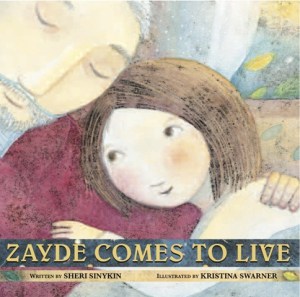
SGL:  Looking over your website, it’s clear you’ve been successful. You have published 19 books for children. Zayde Comes to Live is your first picture book. What made you decide to write a picture book, especially about such a serious subject as death and the afterlife? 

SS:  My mom was diagnosed with Stage 4B endometrial cancer in 1997 and given two years to live. I was terrified, and became a hospice volunteer in Madison in the hope of quelling my fears about death in general.  I also hoped the hospice experience would enable me to be with my mother at the end of her life, which came a miraculous eight-and-a-half years later.  At that time, I was feeling blocked as a writer and entered Vermont College’s graduate program, receiving my MFA in Writing for Children in 2003. While there, I realized that all my previous books had been inspired by my sons’ experiences rather than by my own. I had not written from my own fears, from my own emotional core. Giving up the Ghost, the middle-school novel that evolved from that program, addressed the fear of my mother’s eventual death head on. 

SGL: So Giving up the Ghost was different from your previous novels. Where did the idea for Zayde come from? 

SS:  The character of Zayde was inspired by one of my hospice patients.  But the theme was suggested by a hospice rabbi’s comments at a brunch I attended.  He shared his experience that Jewish patients seem to be more fearful and less accepting of death than other patients.  In his view, this is because Jewish tradition focuses on the Here-and-Now not on the Hereafter.  I realized there was a little girl in me who wanted to know where Mom was going to go, and I went in search of answers. 

SGL:  In Zayde, Rachel has a friend who tells her that her grandpa will go to Heaven if he believes in Jesus.  Another tells her he will go to Paradise if he believes in Allah.  You’ve said that Zayde should be shared with a child by a caring adult rather than by you, the author. Can you explain how you would like to see Zayde used? 

SS:  Only an adult who knows and loves a particular child can determine when that child is ready for the difficult conversation about death.  I have an example from my own life.  One of my sons asked me if I wanted to read Zayde right after it was published to his two boys, then ages three and five. I didn’t think the time was right—they had two healthy grandfathers and my instinct was not to introduce doubts about their health. Two weeks later, I got a phone call: “Mom, we need you and we need your book.”  The boys’ step-grandfather had died unexpectedly in his sleep.  I sat down with the boys and we talked about Papa Ron. I read them my book. They had questions about the “inside” and “outside” of a person–concepts introduced in Zayde Comes to Live.  They had other questions, including the Big One:  “Are you going to die, Nana?” I answered honestly but reassuringly. Months later they were overheard talking to each other in the bathtub. One of them said, “It’s going to be so sad when Mommy and Daddy die someday.” “I know,” his brother replied, “It really is…but we will have each other, and by then, we will have our own families, too.” I strongly believe that how you respond to these kinds of questions can set a child on a path of understanding and acceptance of the circle of life, or a path of fear. Zayde also talks about religion, which is another reason why it might be better for a caring adult rather than a stranger to read this particular book to a child. When you know and love a child, you are in a much better position to assess their emotional readiness, as well as their developmental stage, for this potential minefield of a discussion. 

SGL: Zayde has received excellent reviews as well as several awards, including a Sydney Taylor Honor, awarded by the Association of Jewish Libraries.  It’s every author’s dream to win awards and get rave reviews. How has that felt to you?  

SS:  Since Zayde is my only book to have received such positive attention, the whole experience feels incredible, hard to believe.  I felt especially honored by the Sydney Taylor award because part of my intention was for Jewish children to have a resource that might help them heal grief and carry healthy attitudes about death into adulthood.  The Wisconsin Library Association award validates Zayde for a more universal audience, hopefully helping other children realize that their friends may believe different things about an afterlife, and that’s okay. 

SGL:  You will be presenting your Power Point, “Good Grief: How to Talk to a Child about Death” at Temple Beth El in Madison on Sunday, October 27. What resources did you turn to for creating this presentation?  

SS:  My critical thesis focused on making literature about death and bereavement authentic for child readers.  Giving up the Ghost was informed by that research.   Later, when I was going through my own grief therapy, I drew from those more personal experiences as well. A variety of grief and recovery resources and handouts for adults and children are listed and may be downloaded from my website.  

SGL: One final question.  What is your next writing project? 

SS:  Strangely, I haven’t been moved to write since my parents died and my five grandsons were born. I’m trying my hand at watercolor painting, a real departure for me. I guess for now, I would rather spend my time with real children than with fictional ones. 

For more information on the Wisconsin Library Association’s annual conference held in Green Bay October 23-25, go to:  http://wla.wisconsinlibraries.org/events-conferences/annual-conference/wla-conference-home  Sinykin will be accepting her award on Wednesday, October 23. 

On Sunday, October 27, at 11:00 AM, Sinykin will be presenting her Power Point program, “Good Grief: How to Talk to a Child About Death” at Temple Beth El, 2702 Arbor Dr., Madison.  The event is open to the public, but there is an $18 non-member fee for the brunch.  

For more information on Sheri Sinykin’s books and programs see: www.sherisinykin.com  


Posted on by stephanielowden | 1 Comment

Two More YA Books Not to be Missed

I’m posting this review of two more excellent books I’ve recently read.  Both are suitable for older teens and any adult looking for a really good story. In the publishing world these would be called “crossover” books—stories that appeal to adults as much as to children. 

Personal Effects by E.M. Kokie. CandPersonal Effectslewick Press, Somerville, MA. 2012

Seventeen year old Matt Foster is filled with rage.  His father is a bully, his brother, T.J., was killed in Iraq and some peacenik kid at school has the nerve to suggest his brother died in vain.  When he sees the kid wearing a shirt with the names of dead soldiers, including his brother’s, Matt loses it.   “Pinscher turns and flattens back against the lockers. He’s talking, but I can’t hear him over the roaring in my head. Someone grabs my arm, but I shake him off and pull at Pincher’s shirt.” Matt ends up in the Principal’s office.

Matt’s father acts as if his brother never existed and expects Matt to join the army after high school.  When T.J.’s personal effects arrive from Iraq, Dad hides them away, sending the clear signal that they are not to be touched. But Matt is determined to find out what is in that box.  It’s all he has left of his brother.

In Matt, Kokie has created a troubled but empathetic character. With the help of his best friend, Shauna, Matt embarks on a journey to find out a secret his brother had been keeping.  In the process he will not only learn a new truth about his brother, but will become a stronger person himself, better able to deal with his anger as well as confront his father.

Son by Lois Lowry. Houghton Mifflin Books for Children, New   York, NY, 2012.Son

“The young girl cringed when they buckled the eyeless leather mask around the upper half of her face and blinded her.  It felt grotesque and unnecessary, but she didn’t object. It was the procedure. She knew that. One of the other Vessels had described it to her at lunch a month before.”

Son is the final book in the quartet that began with The Giver.  Reading this book, I experienced the whole spectrum of emotions from fear, to grief, to heartbreak to joy.  I chose to re-read the three previous books of this series, The Giver, Gathering Blue and Messenger, but it is not necessary.  Each book stands on its own. Son is the resolution of the events that take place in The Giver.

Claire lives in an ultra programmed community where everyone is assigned a job according to their abilities. One of the lowliest jobs is Vessel, young women who give birth. The babies are then assigned to the proper married couple that is deemed to be the best parents for that particular child.  Claire, as a Vessel, knows that she will give birth to a child she will not be allowed to ever see or meet.  But circumstances change when the birth does not go as planned and she inadvertently discovers she has a son. Son takes Claire on a journey of self discovery as she is determined to find the son that was stolen from her. A sense of loss and longing permeates this novel, undoubtedly because Lowry lost her own son in a military accident.  Prepare to shed more than a few tears when reading this one. 


Posted in Uncategorized | 1 Comment

A Greyhound of a Girl & The Revolution of Evelyn Serrano

  A Greyhound of a Girl by Roddy Doyle. U.S. edition Amulet/Abrams, 2012, New York, NY.A-Greyhound-of-a-Girl

This story, about a great-grandmother ghost and her very much alive great-granddaughter, is typically Irish. I say that with some hesitation, because I am not Irish and my experience with Irish stories is that they usually end badly. Reading Morgan Llywelyn’s series she calls The Irish Century I was alternately shocked, angered, and tearful. And don’t even get me started on Leon Uris’ Trinity. But A Greyhound of a Girl is a novel for the younger of the young adult set.  It does end well, and in the meantime the reader will get the impression that it’s not “at all, at all,” unusual for ghosts to be walking around Dublin talking to folks cleaning up some unfinished business or other.

You may recognize Roddy Doyle as the author of the Commitments, The Snapper and The Van—all Irish comedies that were made into movies. If you haven’t seen them, I recommend you do—and they also do not end tragically as so many Irish stories do. (I have not been able to find The Van on DVD, however.)

A Greyhound of a Girl starts with twelve-year-old Mary who has a variety of problems. Her best friend has moved away, she thinks her mother’s speech pattern is too full of exclamations (She tells her mother, “Even your whispers end in!!!s,”) and her granny is in the hospital, probably dying. Then she meets this old woman walking home from school one day.  Using flashbacks to tell the story of one family’s history, Mary learns about her granny’s past and lives through some exciting days in the present.

Read this one and enjoy.  It is delightful and different from anything else I’ve read.

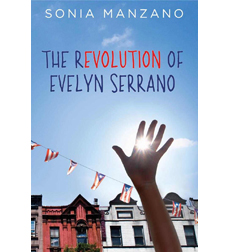
The Revolution of Evelyn Serrano by Sonia Manzano. Scholastic Press. New York, NY, 2012.The Revolution of Evelyn Serrano

Evelyn’s life is turned upside down when her eccentric, and revolutionary grandmother, comes to live with her family in their 1960’s barrio of New York. Evelyn, whose first name is Rosa, decides to take her middle name, Evelyn, because there are so many Rosas in the neighborhood.  At the cusp of womanhood, she questions her Puerto Rican heritage and dislikes how her mother acts:  “I hated that beggy voice of hers. She sounded like a slave.”  Searching for her identity as a unique individual, she fixes up her own bedroom, not “decorated in late 1960’s Puerto Rican décor—plastic covering all the furniture and fake roses everywhere. Which was Mami’s way of making our home look pretty.” Evelyn’s room is off-limits.

When her flamboyant Abuela comes to stay and takes over Evelyn’s bedroom with “scarves, tops, and skirts in bright colors” make-up and jewelry everywhere, Evelyn escapes to el roofo to find some privacy and hang out with her friend, Angel.  She soon learns that her own mother does not know her grandmother well at all because Abuela was always off somewhere, fighting for some cause when Mami was growing up.  The two fight constantly: Evelyn’s mother, the conservative averse to risk; Abuela, the free spirit who finds a cause right there in Evelyn’s own neighborhood.  At first angered by her grandmother’s presence, Evelyn undergoes a change herself, and becomes determined to make her grandmother’s cause her own.  In the process, Evelyn discovers her own heritage and a new relationship with her mother.

The Revolution of Evelyn Serrano gave me insight to a place and culture I knew little about. Although I, too, was a teen in the 60’s, I was never exposed to or heard about what went on the barrio. Living near Milwaukee, I knew of the African-American struggles for open housing in that city and the marches led by a “radical” priest named Father Groppi.  I was not even familiar with the word, barrio.  This book opened my eyes to another culture’s history during a tumultuous time in our own American history.


Posted in Uncategorized | Leave a comment

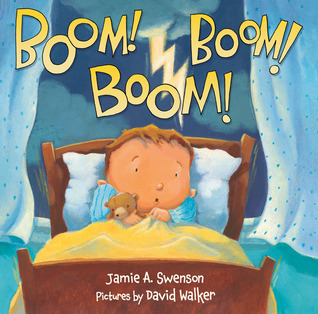
Boom! Boom! Boom! By Jamie A. Swenson, pictures by David Walker. Farrar Straus Giroux, New York, NY, 2013.  Boom Boom Boom

When this book came out, I knew I had to have it. No, not for my grandchild, although I’m sure I will read it to her in the future. This one is for me. You see, I really am afraid of storms.  If it even looks like a tornado could form, I’m down in my basement.  The story is told that when I was very young, I was standing next to our barn when lightening struck its lightening rod. All I remember is my mother’s scream. I was completely unharmed, but that clinched it. I do not like storms.

The small boy in Boom! Boom! Boom! settles into bed with his stuffed bear, Fred.  When thunder starts crashing around outside they are joined by the dog.  Pretty soon the cat joins them, then guinea pig, frog, parrot, snake and finally, “Sis jumped in with elbows flying. The bed groaned, and creaked and then stopped trying.”

In the end, the small boy figures out a solution to the destruction in his room and finally gets some sleep.

The cadence of the rhyme makes this one of those books that is just as much fun to read for the adult as well as the child. David Walker’s eye-catching illustrations will appeal to the youngest child.  But beware!  They may want to bring all their toys and pets to bed with them.  But then, parents of frightened children will undoubtedly have experienced a similar bedroom menagerie at some point already.

Grandma’s Beach by Rosalind Beardshaw. Bloomsbury Children’s Books, New York, NY, 2001.  Grandma's Beach

Every child of a working parent has had a day like this.  Mom promises to take Emily to the beach.  Just as they finish packing the car, Mom’s phone rings.  She has to go to the office and Emily has to go to Grandma’s. But Grandma doesn’t live near a beach.  When Emily arrives at Grandma’s with a long face, Grandma tells her to get all her beach things out of the car.  So, while Emily changes clothes, Grandma gets busy recreating a beach in her own yard.

Every grandma, and every child lucky enough to be cared for by one, will delight in this simple story and kid friendly illustrations. The portrayal of how a loving adult tries—and succeeds—at turning a disappointing day into a day at the beach will appeal to any caregiver who’s been confronted with a disgruntled pre-schooler.  With the help of a kiddie pool, a sand pile and, of course, a hose, Emily’s day turns into such fun that when Mom picks her up and suggests they go to the beach tomorrow, Emily replies, “That’s ok, Mom. I like Grandma’s beach best.”

And why not?  Spending time with a caring adult, especially a grandma this creative, beats a crowded beach any day.

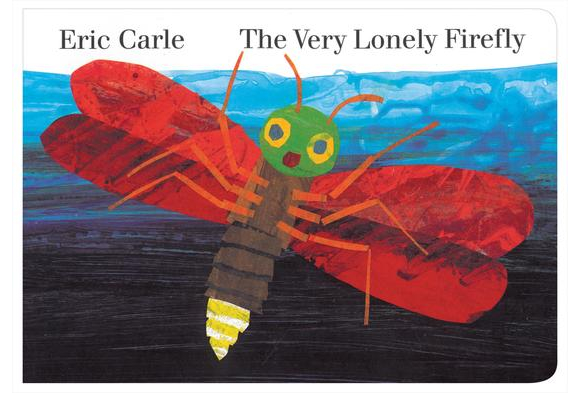
The Very Lonely Firefly by Eric Carle. Philomel Books, New York, NY, 1995.

The Very Lonely Firefly

Considering this book came out in 1995 I’m surprised I wasn’t aware of it until now.  The popularity of Carle’s The Very Hungry Caterpillar has probably overshadowed this one. But while I was sitting in my living room the other night, looking out the window and seeing the first flickering of fireflies in my yard, I got to wondering: there must be a firefly book out there. And so I discovered The Very Lonely Firefly. So far, in my yard at least, I’m guessing the fireflies are indeed lonely as I’ve seen only a very few.  But perhaps more will appear soon.

This book is really two stories. The story of the title in which this little firefly searches for others like him but keeps seeing lights that turn out to be everything from a light bulb to…well, I don’t want to spoil the ending.  The other story involves the humans the firefly follows as they are the ones with the artificial lights.  And they are involved in a mystery.  “Hear that noise?” the man says to the woman, light bulb dangling overhead.  “What’s going on?” the woman asks as she lights a candle.  “Quiet out there!” the man yells as he begins to search for the cause of the noise outside.  Soon two children are searching with lanterns in a quest to find out what that noise is all about.

I won’t spoil the ending, but suffice it to say the little firefly does indeed find more creatures like itself.

Eric Carle is known for his boldly colorful collage illustrations.  I encourage anyone interested in art to visit his website here, click on the photo and video gallery, then on “How I create my pictures.” Folks like me, who can barely draw a stick figure, will be amazed at how he created his famous caterpillar.  Tissue paper collage looks extremely tedious to me but he makes it look so simple.  An older child who dreams of being an artist someday will be fascinated by this mini tutorial into the technique of this famous writer and illustrator of children’s books.


Posted on by stephanielowden | Leave a comment

Leave the Yard Work and Head to the Beach!

Flip, Float, Fly seeds on the Move by JoAnn Early Macken, illustrated by Pam Paparone. Holiday House, NY, New York, 2008.

EPSON scanner image

Be prepared to appreciate those maple seeds inhabiting your planters and dandelion seeds floating through the air when you read this book.  Like many a gardener I fight with those helicopter-like seeds my maple trees seem intent on planting in my container gardens.  And don’t get me started on dandelions.  But being a sometime kindergarten teacher, I know the allure of dandelions to young children.  They seem to just go together: small children and those yellow flowers that most adults feverishly try to eradicate from their yards. Some teachers forbid the kids from bringing them into the classroom, but I’m just an old softie, I guess.  I just don’t have the will to tell a little girl to throw away the dandelions she so carefully picked for me.  (Instead I quietly throw them away later.)

Flip, Float Fly is a lovely non-fiction picture book from which I learned what those weird looking seed pods are that I see sometimes on walks in my neighborhood. Locust tree pods. I don’t have a locust tree in my yard but I see them everywhere and now I know what they are.  I love the tree’s fern-like leaves that seem to turn silver, quivering in the wind.

Early Macken’s perfect prose tells how seeds get carried away and replanted in new places: by water, wind, and even bats: “A bat finds a feast in a fig tree and wings away with the seeds inside.  The seeds pass through its body unharmed and fall to the ground in its droppings.”  Squirrels hide acorns “…and bury them to eat later. But does it use all the food it collects? No. Lost acorns can grow into strong, shady oak trees.”  My yard has a prolific squirrel population so when I’m digging in the soil I’m forever finding acorns the squirrels have “squirreled” away.

The realistic acrylic paintings by Pam Paparone are a riot of color.  One favorite page of mine depicts a garden with everything from carrots to roses.  A small boy carries a potted hydrangea bigger than he and a small dog waits for a ride in a wagon.  A seed package is tipped over in the corner, flower seeds spilling out.  Several pages have easy to read diagrams of the parts of plants, such as the flower, fruit, leave, pod, etc. set off in a white circle so even the youngest child’s eyes will be drawn to them.

The last three pages have diagrams of the parts of plants with definitions and notes on what conditions seeds must have in order to take root, grow and make more seeds.  This is the perfect book to read to that young gardener in your family who is helping parents or grandparents with planting.  There’s still time.  I’ve been told you can plant spinach all summer. But I’m finished planting.  Now to pull out the dandelions and pick the “helicopters” out of my containers.

Or maybe I’ll just go to the beach….

Beach Feet by Kiyomi Konagaya, illustrated by Masamitsu Saito. American edition published by Enchanted Lion books, NY, New York, 2012.  Originally published in Japan, translated by Yuki Keneko.

Beach Feet

“I’m at the beach! Yippee! The warm salty breeze tickles my nose. My shirt is off and I’m ready for the waves.”  A small boy heads for the beach clutching an inner tube. But wait—his flip-flops keep sinking and slow him down, so he takes them off. But then, “Ow! The sand is burning hot!” 

In this delightful book of few words, the pastel and watercolor illustrations tell the story.  Throughout the book the reader’s eye is drawn to the little boy’s feet: in hot sand, cold wet sand, and salty water that “…tickles my toes.”

Although the boy’s feet are always the focus, the water practically splashes off the page in roiling waves. Saito grew up in a seaside town and his fascination with water makes this book a feast for the eyes. Reading this, I felt like I could almost jump into the water along with the little boy.  I rarely get to the ocean, but once a year I try to swim in Lake Superior to play in the waves. Sometimes I even take an inner tube. This is the perfect “beach book” for the little ones just becoming acquainted with the beach.


Posted in Uncategorized | Leave a comment